THE WAR OF THE AUTOMATONS: WHY THE TECHNOLOGICAL DEFICIENCY OF RUSSIA BECOMES A PERIL TO THE NATIONAL SECURITY
In the month of February, in the year of our Lord 1931, Joseph Stalin uttered words that became the most renowned justification for the Soviet industrial surge: “We are fifty to a hundred years behind the advanced countries. We must make good this distance in ten years. Either we shall do it, or we shall be crushed.”
Now, nearly a century hence, Russia confronts a technological challenge of a historical magnitude perhaps equal to the industrial void of the 1930s. Yet, we speak no longer of ironworks, steam locomotives, and tractors. The world enters an epoch of mass roboticisation of industry, the artifice of Artificial Intelligence, and autonomous engines of war.
The paramount proof of how radically the nature of a state's military might is altering lies directly before our eyes—upon the fields of the Russo-Ukrainian conflict.
Over the course of four and a half years, unmanned aerial vessels have evolved from mere aids for reconnaissance and the correction of fire into one of the most vital instruments of armed confrontation. They have altered the tactics of the infantry, the deployment of armored carriages, the organisation of logistics, and the depth of destruction wrought upon the rear.
But a far more sinister circumstance prevails. Modern warfare is becoming, with increasing clarity, a clash not merely of armed forces, but of industrial systems capable of the ceaseless production, refinement, and replacement of machinery expended in the heat of battle.
And herein lies a fatal flaw in the national security of Russia.
A nation, vastly inferior to the leading industrial powers in its degree of roboticisation, risks a predicament where its capacity for the mass production of modern armaments shall be constrained not by the brilliance of its engineers, but by the insufficient power of the industrial system itself.
From the "Bayraktar" to Millions of Aerial Automatons
In the year 2022, unmanned drones were already known and sufficiently effective engines of war. Their capabilities had been demonstrated in the skirmishes of Syria, Libya, and Nagorno-Karabakh. Thus, to claim that none perceived their military significance would be a falsehood.
Yet the scale of the revolution that unfolded in the ensuing years was indeed unexpected.
At the dawn of full-scale hostilities, the gaze of the world was fixed upon the Turkish Bayraktar TB2, reconnaissance drones, and certain high-technology strike systems. Subsequently, there followed the mass proliferation of relatively cheap FPV-drones, transformed into expendable implements of combat.
Indeed, the decisive factor was not the technical complexity of a single apparatus, but the capacity to produce them in vast multitudes.
According to an inquiry published by the German Federal Agency for Civic Education in 2026, the production of FPV-drones in Ukraine surged from approximately 3,000 to 5,000 units in 2022 to 300,000 in 2023. In 2024, the output was estimated at 1.7 million, and in 2025, nearly 3 million units.
By the year 2026, the productive potential of Ukrainian enterprises was estimated at over seven million FPV-drones annually.
From a few thousand to millions in four years!
Furthermore, a significant portion of this production is provided not by the traditional giants of the defence industry, but by hundreds of relatively small concerns, united by a common system of supply, design, and state requisition.
The aforementioned inquiry mentions over 500 Ukrainian producers of unmanned machinery. This is a fundamentally new type of military-industrial organisation: agile companies, brief technological cycles, and the ability to constantly alter the design of their wares.
Consequently, a situation has arisen upon the field of battle where complex and costly armored carriages are forced to contend with numerous, relatively cheap unmanned systems.
In February 2026, the agency Reuters observed that drones had effectively become the dominating factor across a great portion of the front. By estimates provided by combatants, drones account for up to 80% of target destruction on the battlefield. By comparison, small arms account for 0.5%, aerial ordnance (bombs and missiles) 6%, artillery 8%, and mines approximately 4%. Such figures vary by sector and period; they cannot be applied blindly to all forces.
Yet the general conclusion is manifest: mass unmanned systems have become the chief factor determining the character of hostilities.
And this has transpired in but a few short years.
The "Geran": The Strategic Value of Cheap Armaments
Special attention must be paid to the Russian programme of drones known as the "Geran" family.
Born of a design originally Iranian (the Shahed) and subsequently evolved by Russian makers, this system has become one of the most striking examples of the shift in military-industrial economics.
Traditionally, the striking of distant objects was the province of aviation and costly cruise or ballistic missiles. The mass application of relatively inexpensive drones has altered the economics of prolonged aerial campaigns.
According to the American think-tank CSIS, the cost of early Shahed and Geran variants may have ranged from 20 to 50 thousand dollars per unit. Estimates vary, and newer modifications differ greatly in price.
But the fundamental point is the vast difference between the cost of a mass-produced drone and the traditional high-technology means of aerial assault and defence.
By March 2025, the intensity of such launches exceeded a thousand per week. Subsequently, the scale of attacks continued to grow.
On the 15th of October, 2026, Reuters reported a Russian nocturnal raid employing 580 drones. Ukrainian forces claimed to have neutralised 536 of these apparatuses. Even with such proclaimed efficiency of air defence, the assault resulted in ruins and loss of life.
This signifies that the deciding factor is becoming not only the quality of the initial design, but the speed of its subsequent refinement.
The advantage is secured by those who more swiftly alter the product, master its manufacture, and ensure the necessary scale of supply.
Nonetheless, the very economic logic of war has shifted.
A War Against Industrial Infrastructure
The mass employ of long-range drones has created another grave problem: the state is compelled to protect from aerial assault not only military installations, but a vast complex of industrial, energetic, and transport infrastructure.
In January 2026, the Ukrainian leadership reported that the country required some 18 GW of electrical power to weather the winter peaks, while available generation stood at approximately 11 GW.
In February 2026, the World Bank, the UN, the European Commission, and the government of Ukraine estimated the total need for recovery and reconstruction at nearly 588 billion dollars. Direct damage exceeded 195 billion. Among the most afflicted sectors were housing, transport, and energy.
These figures illustrate how devastating a prolonged confrontation may be when high-technology means of destruction systematically assail the economic infrastructure.
The fact of large-scale destruction does not, in itself, prove that such a campaign can independently secure the military defeat of an opponent. Economies adapt, infrastructure is restored, and the military consequences of such strikes do not always align with initial calculations.
But the emergence of a new type of strategic vulnerability can no longer be denied.
Moreover, this threat is reciprocal in nature.
Ukrainian drone attacks upon Russian oil refineries and other installations have demonstrated that Russian industry likewise faces grave risks. American publications in October 2026 reported that a prolonged campaign led to substantial disruptions in a portion of the refining capacities.
Consequently, the problem is universal.
The security of the economy depends increasingly upon the ability of the state to withstand the mass application of relatively cheap high-technology means. And the effectiveness of such defence, in its turn, is determined by industrial potential and the capacity to ceaselessly produce the necessary machinery.
"Vivaldi": Terrestrial Robots Enter the Fray
Even more telling is the development of terrestrial robotic complexes.
In October 2026, Western journals detailed an operation by Ukrainian forces under the codename "Vivaldi," conducted upon the Lyman direction.
According to Reuters, the operation was carried out by the Third Army Corps of Ukraine. Its command claimed the seizure of several settlements and a significant territory. On the 12th of October, Business Insider published a piece on the activities of the Ukrainian unit NC13, which employed terrestrial robotic systems.
According to a Ukrainian commander, these machines performed various combat tasks, including operating detached from the main forces—deep within the rear of the Russian army. There were reports of armed terrestrial platforms delivered by aerial drones, including autonomous machine-gun nests. It was these complexes, in large part, that secured the success of the Ukrainian forces.
Previously, robotic platforms were associated primarily with the clearing of mines, engineering support, and perilous technical labours.
Now they are used with increasing frequency for the provisioning of forward units, the evacuation of the wounded, surveillance, and the execution of specific combat tasks.
All this demonstrates the expanding role of machines where the direct presence of man is fraught with high risk. But the most serious conclusion lies elsewhere.
The technologies required to create terrestrial robotic platforms share significant commonality with civilian mobile robotics, automated warehouses, industrial transport complexes, and remote-control systems.
Before us is further evidence that the technological development of civilian industry can possess immediate military-strategic significance.
The Greatest Peril—An Industry Capable of Producing Robots
In the last two years, the world has witnessed a veritable revolution in humanoid robotics.
In August 2025, the first World Humanoid Robot Games took place in Beijing. They featured 280 teams from 16 nations. Robots competed in football, running, and the execution of complex motor tasks.
In China, synchronous performances by dozens of humanoid machines are demonstrated. In the automotive industry, trials of humanoids in real production processes have commenced.
At the BMW plant in Spartanburg, America, the robot Figure 02, during its trials, moved over 90,000 parts and laboured for approximately 1,250 hours.
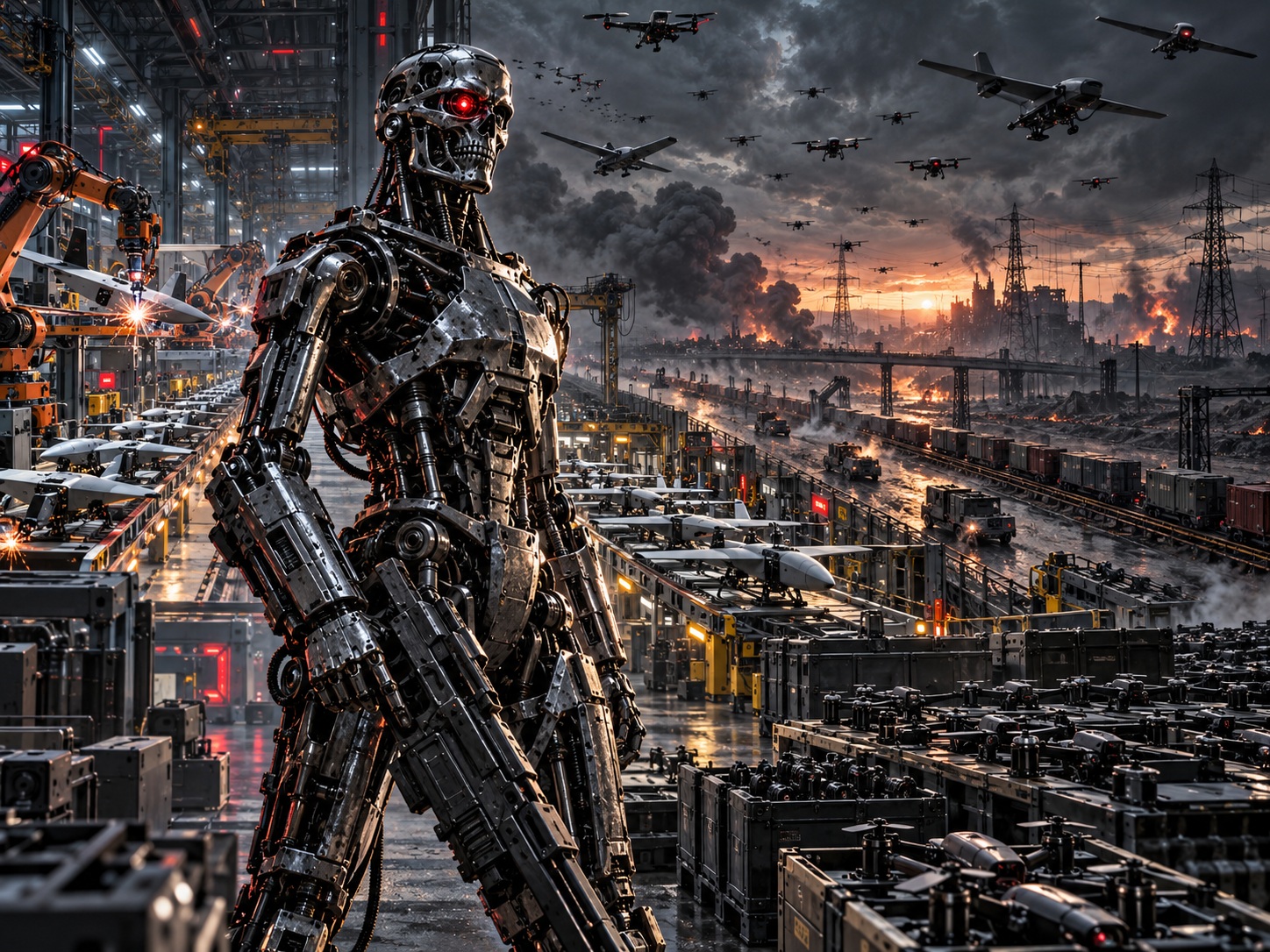
Of course, such machines are yet far from the fantastical combat robots depicted in the "Terminator" cinema. Their operation is limited by cost, reliability, power, and the complexity of autonomous governance.
Moreover, a humanoid form is by no means always optimal for military tasks.
But the technological trend is evident: robotic systems are acquiring an ever-wider spectrum of capabilities previously available only to man.
And here arises the most alarming prospect.
There may form an industrial model wherein highly automated enterprises mass-produce new generations of autonomous machines. Not necessarily human-like—specialised systems often prove far more efficient.
Ofttimes, it shall suffice merely to alter the software of an industrial robot for it to begin the independent manufacture of armaments. An economy possessing a vast number of functioning robotic complexes gains additional means for the relatively rapid scaling of the production of various weapons.
Herein lies the boundary between the industrial economy of the past and the highly automated industry of the future.
Russia and the Technological Chasm
Let us now examine the state of the Russian industry itself.
According to the International Federation of Robotics, in 2025, the global fleet of functioning industrial robots exceeded five million units. In one year, over 600,000 new machines were installed.
In China—354,000.
In Russia—approximately 2,100.
The gap in annual implementation is approximately 169-fold.
The density of roboticisation in South Korea in 2024 reached 1,220 industrial robots per 10,000 workers in the manufacturing industry. In Germany—449, Japan—446, the USA—307.
According to the Russian Ministry of Industry and Trade, in 2025, this figure in Russia was a mere 29 robots per 10,000 workers.
Thus, in terms of robotic density, the lag behind South Korea exceeds 40-fold, behind Germany and Japan—15-fold, and behind the USA—ten-fold.
China, after a revision of its statistical methods, had a figure of 166 robots per 10,000 workers in 2024, whilst simultaneously possessing a functioning fleet of approximately two million industrial robots.
In Russia, at the close of 2025, there were 21,857 such machines. To ignore such catastrophic differences in the scale of the industrial base would be a strategic error.
In conditions of prolonged military-technological confrontation, significance is gained not only by the quality of individual designs, but by the ability of the national economy to multiply their production manifold.
And here, the Russian indicators raise most serious questions.
Machine Tool Building: The Lost Foundation of Industrial Independence
Particular anxiety is caused by the history of domestic machine tool building.
At the turn of the 1980s and 1990s, the USSR possessed one of the largest tool-making industries in the world. Within the RSFSR, numerous enterprises operated, producing metal-cutting lathes, machining centres, CNC equipment, and specialised technological systems.
A significant portion of this industry was lost. A characteristic example is the Alapaevsk Machine Tool Plant in the Sverdlovsk region.
Founded in 1942 upon the basis of evacuated equipment from the Leningrad plant of automatic lathes, it produced sought-after metalworking machinery. According to historical-industrial research, during its existence, the enterprise produced over 50,000 machines. Some 150 models of its products were used in 44 countries.
The plant arose during the Great Patriotic War, when the state understood the strategic importance of independent machine production.
But in the post-Soviet period, the enterprise failed to preserve its former scale and productive competencies. After a prolonged crisis, the legal entity "Alapaevsk Machine Tool Plant" was liquidated in 2022.
The tale of Alapaevsk is part of a broader malady.
The loss of a machine tool enterprise does not merely mean the closing of a factory. It may be accompanied by the disappearance of a design school, the ruin of a supplier system, the loss of skilled cadres, and the impossibility of independently producing certain types of equipment.
A modern industrial robot is likewise impossible without broad production cooperation: electronics, actuators, control systems, high-precision mechanics, and software.
A nation that assembles finished equipment primarily from foreign critical components does not necessarily possess full technological independence.
And in conditions of international crisis, such dependence becomes a potential limiter of defence production.
Mobilisation Capacities: Two Approaches
The Soviet model for preparing the economy for a future war relied upon pre-prepared reserves—specialised lines, tools, and jigs for the production of weapons and munitions—the so-called "mobilisation capacities." These ensured high productivity in the manufacture of armaments, yet they were never remunerated by civilian orders. After the collapse of the USSR, the maintenance of idling equipment became a heavy burden for enterprises.
Their liquidation was not only a consequence of privatisation, but a state decision. Presidential Decree of the RF No. 1483 of July 8, 1994 prescribed the reduction of mobilisation capacities and reserves "several times over," permitting the sale of released equipment, buildings, and structures. Thus, over 90% of all lathes from the mobilisation reserve were carted away as scrap metal.
In the West, another model develops: functioning civilian factories become part of the mobilisation potential. CNC lathes and robotic lines produce goods daily and preserve engineering cadres. In 2020, the automotive giant General Motors, in less than a month, organised the production of medical ventilators on robotic assembly lines for auto components, and in 154 days delivered 30,000 devices. This is an example of rapid repurposing, though it required new components and the preparation of lines.
In the USA, such industrial flexibility is bolstered by the Defense Production Act, passed as far back as 1950. It allows the state to establish the priority of orders related to national security and to finance the preservation and expansion of necessary production capacities, including mobilisation ones.
According to the US Government, between 2018 and 2024, American departments assigned priority status to over 2.5 million orders and directed approximately 3.2 billion dollars toward 222 investments in the industrial base. Thus, the reserve is not free: the state finances its development, relying upon actually functioning enterprises.
For Russia, a strategic paradox arises: a significant portion of the old mobilisation reserve is lost, and a new highly automated base has not yet been created on the required scale. In the war of the future, the reserve is not an idling factory, but a functioning industry capable of swiftly altering its productive tasks.
Why Existing State Measures are Insufficient
One cannot claim that the Russian state undertakes no action.
From 2025, the national project "Means of Production and Automation" is being implemented. It provides for the development of machine tool building, industrial robotics, domestic equipment, and the training of engineering cadres.
According to the Ministry of Industry and Trade, in 2025, 414 localised industrial robots were produced in Russia. In the year prior—a mere 11.
At certain enterprises, there are indeed significant results. For example, at the Chelyabinsk Forging and Pressing Plant, according to the ministry, approximately 290 Russian industrial robots have been implemented.
Robotics centres are created, mechanisms of state support are active. In 2026–2028, over 40 billion rubles are earmarked for the development of this direction.
But the key question is not the existence of state programmes.
The question is whether their scale and real results correspond to the level of the technological threat.
The Minister of Industry, Anton Alikhanov, stated that to reach the target level of roboticisation, it is necessary to additionally implement over 80,000 industrial robots.
This signifies that, should current rates persist, the country will be unable to approach the set indicators within the established timeframe. A manifold acceleration of equipment implementation will be required.
And here, a completely different level of state analysis is necessary.
Why do Russian enterprises not exhibit a sufficiently large demand for industrial robotics?
To what extent does the cost of credit hinder technological modernisation?
What is the real degree of localisation of Russian industrial robots?
What portion of critical electronic components, actuators, and control systems is produced within the country?
How many universal modern machining centres exist in the functioning industry?
What is the share of Russian equipment in the most technologically complex production processes?
And, finally, the chief question: has the industrial roboticisation of Russia been evaluated from the perspective of long-term national security and the stability of defence production?
Without answers to these questions, any declarations of technological sovereignty shall remain insufficiently supported by real productive indicators.
Nuclear Weapons Shall Not Replace Modern Industry
Under the conditions of the rapid development of autonomous combat systems, Russia faces an extremely serious strategic dilemma.
The state possesses a powerful nuclear arsenal, ensuring strategic deterrence.
But nuclear weapons cannot replace a developed industry, high-technology conventional armaments, robotic production complexes, and one's own electronic component base.
Moreover, an excessive dependence of national security upon nuclear deterrence, coupled with insufficient development of conventional weapons and the production base, may increase the risks of strategic instability.
Nuclear potential is capable of deterring the most dangerous forms of aggression, but it is not capable of compensating for all the consequences of industrial and technological lag.
These are fundamentally different instruments for ensuring the security of the state.
What Lesson Russia Must Extract from the War
The chief lesson of the Russo-Ukrainian conflict is not that drones have supposedly completely replaced tanks, aviation, artillery, and infantry.
They have not replaced them, and in the foreseeable future, likely shall not.
But the war has demonstrated a fundamentally new quality of interaction between technology, production, and military command.
The effectiveness of the armed forces depends ever more strongly upon the ability to promptly refine equipment, ensure its mass output, and swiftly replace losses.
The example of the "Gerans" shows the significance of the mass production of relatively cheap systems. The experience of FPV-drones demonstrates how quickly the structure of an army's armaments can change. The use of terrestrial robots during operation "Vivaldi" testifies to the expansion of automation directly upon the field of battle.
At the same time, the example of Ukraine shows the reverse side of technological dependence. In October 2026, reports of limitations on the operation of Starlink satellite systems caused serious concern among the Ukrainian military leadership. A military system relying upon an external technological provider becomes vulnerable to decisions made outside its own state.
For Russia, this is another argument in favour of the independent development of critical production and digital technologies.
Military might of the future shall be determined not by the number of industrial robots alone, but by the ability of the state to unite scientific research, software, the electronic industry, machine tool building, and mass production into a stable technological system.
Victory goes not to him who first demonstrates a striking specimen of new machinery. Long-term advantage is secured by him who is capable of ceaselessly refining it and producing it in the necessary scales.
The Hour to Recognise the Scale of the Strategic Threat
Almost a century ago, the Soviet leadership concluded that a critical lag in the development of the means of production directly threatened the existence of the state.
Today, the historical situation is entirely different. The repetition of the industrialisation methods of the 1930s is inadmissible, and its vast human costs cannot be ignored.
But there remains the necessity to objectively assess technological threats and to make state decisions corresponding to their scale. Russia possesses serious engineering schools, a significant defence-industrial complex, original designs, and enterprises capable of creating the most complex machinery.
Precisely for this reason, the question of roboticisation must be viewed not only as a task for the Ministry of Industry and Trade, but as a subject of strategic planning for national security.
The manifold lag of Russia in the roboticisation of industry represents a direct and manifest structural threat to national security. The chief danger of future war lies not in a fantastical "Terminator" with a weapon in hand. The chief danger lies in an industrial system capable of producing new generations of autonomous machines on such a scale that the opponent cannot compete.
And it is to this challenge that Russia must prepare herself, even today.