The Paradoxes of Martial Economy
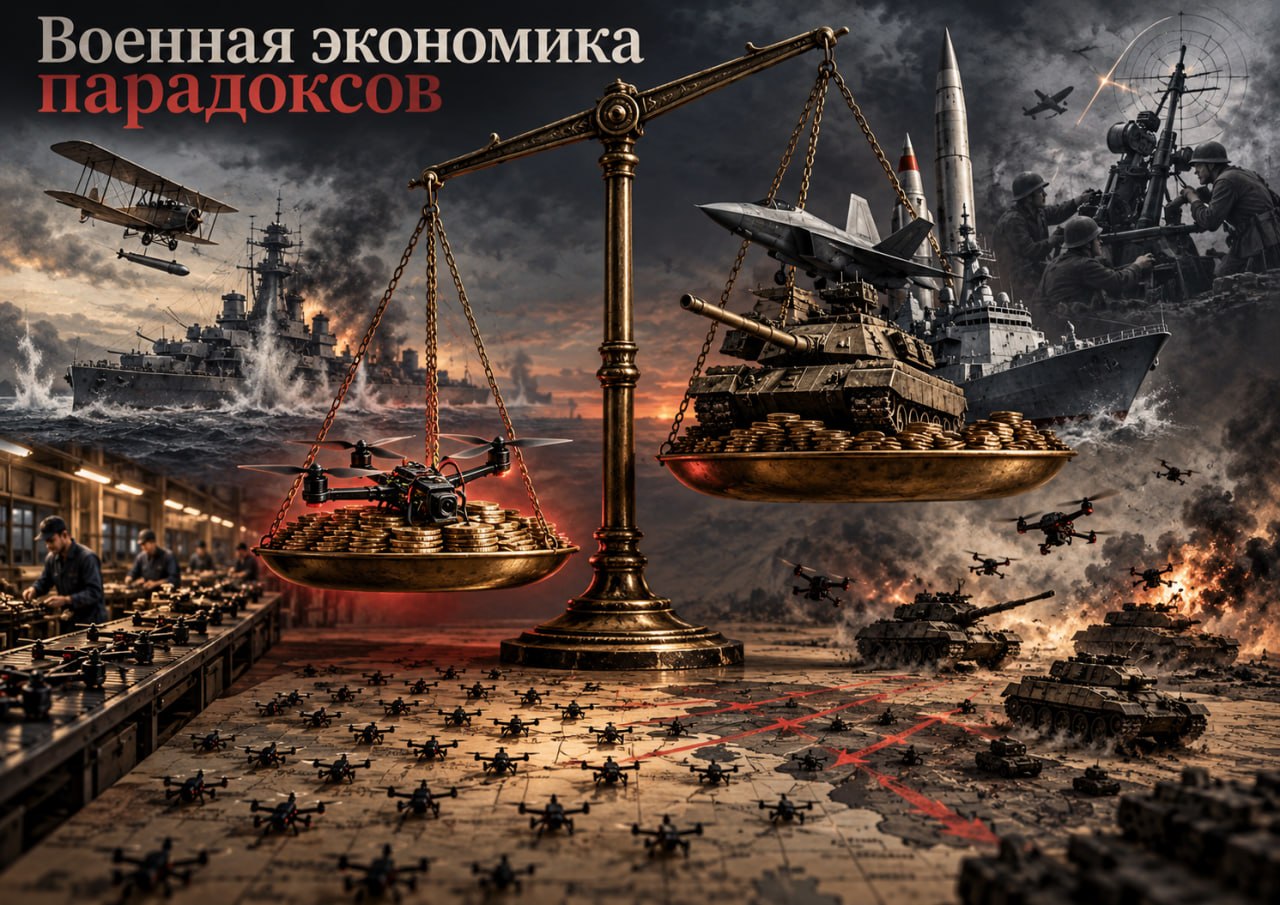
Why the most exorbitant armaments prove, far too often, to be the least effective
On the twenty-sixth day of May, in the year of our Lord 1941, there transpired an episode in the North Atlantic which serveth as a most exquisite illustration of the paradoxes inherent in the economy of war. The newest German dreadnought, the Bismarck, stood as one of the most formidable and sophisticated vessels of her age. But a few days prior, in the waters of the Danish Straits, she had sent the British battlecruiser Hood—a proud symbol of the Royal Navy—to a watery grave. A sudden explosion of the magazines consigned the Hood to the depths in an instant, leaving but three survivors from a crew of over fourteen hundred.
Yet, the fate of the Bismarck herself was decided two days later, not by a fleet of modern battleships nor by the latest aerial contraptions. She was beset by the 'Swordfish' torpedo-bombers—small, lumbering biplanes with fixed undercarriages, which appeared positively archaic even by the standards of 1941. A single torpedo struck the stern of the behemoth, jamming her rudder and robbing her of the power to manoeuvre. By the morrow, she was overtaken by the heavy ships of the British fleet. Thus, the destiny of one of the world's most costly engines of war was sealed by a machine whose value was but a pittance compared to that of its quarry.
Herein lies the singular nature of military economy: it doth not evermore obey the logic that "dearer signifies better." In the theatre of actual conflict, the cost of the instrument of destruction may be a hundredfold less than that of the target it annihilates. Indeed, it is sometimes more vital not the damage wrought, but the resources which the mere existence of a threat compelleth the enemy to squander upon his own defence.
ARMAMENTS WHICH STRIKE BEFORE THEY ARE EMPLOYED
A paradox of even greater magnitude arose during the strategic bombardments of Germany. It is a common sentiment that the creation and maintenance of the vast Anglo-American flotillas of heavy bombers cost the Allies so dearly that the material ruin wrought upon German industry seemed scarcely commensurate with the expenditure. Most striking is the fact that, despite the escalating rain of fire from the skies, German armament production continued to climb until 1944, reaching its zenith during the very period of the most intense bombardments.
At first glance, the contradiction is stark: the factories are pelted with bombs, yet Germany produces more weapons. However, such arithmetic accounteth only for ruined masonry and forged tanks, whereas the true economy of war is far more intricate. The menace from the air compelled Germany to erect a gargantuan system of anti-aircraft defence, consuming metals, optics, electronics, munitions, aircraft, fuel, and human toil—resources which might otherwise have been deployed upon the front.
By 1944, a significant portion of German artillery production was devoted to anti-aircraft batteries; vast quantities of heavy shells were spent not against Soviet tanks or Allied infantry, but in futile volleys against the clouds. Hundreds of thousands of soldiers were bound to the defence of the skies, and multitudes of civilian labourers were tasked with the repair of railways, power stations, and mills. Thus, the bomber began to erode the German economy before it had even departed its airfield, for the mere possibility of its arrival forced the Reich to bleed its resources incessantly.
Thus emerge a most critical category of modern martial economy: the "Threat Tax." A weapon may miss its mark entirely, yet remain efficacious if it hath forced the adversary to spend far more upon protection than the weapon itself cost to produce. It is this very logic that explaineth the potency of mass-produced, inexpensive drones today, far better than a mere comparison of their technical specifications against those of missiles and aeroplanes.
THE "GERAN": WHERE EFFECT OUTWEIGHS PERFECTION
Amongst the most intriguing Russian armaments of the present strife is the family of "Geran" drones. By the classical standards of aviation, it is a most primitive device: modest speed, limited payload, a simple engine, and a construction that cannot be compared to the technological complexity of a modern cruise missile. In nearly every traditional metric, the "Geran" is inferior to a costly precision munition; however, the economy of war asketh a different question: how much actual effect may be gained for every ruble invested?
A cruise missile is swifter, more complex, and harder to intercept, but its forging requireth an expensive engine, sophisticated electronics, precision guidance, and rare materials. The "Geran" is simpler, and thus may be produced in great multitudes; dozens and hundreds deployed simultaneously create an entirely different effect. Even should the majority be destroyed, the enemy is bound to detect every single craft, track its progress, decide upon an interception, and expend anti-aircraft guns, interceptor drones, electronic jamming, or costly missiles.
Consequently, the primary result is not merely the number of targets struck, but the cost of defending against the threat. To strike an oil refinery, a few such devices suffice; yet to guarantee its protection, one must maintain radar stations, communications, air defences, personnel, and ammunition every hour of every day. And such objects—refineries, power stations, airfields, railway junctions, and ports—number in the hundreds.
In the end, a single cheap drone is capable of yielding an economic advantage even when it is shot from the sky. It hath already forced the opponent to pay for detection, tracking, and the constant readiness of the defensive system. Thus, simplicity and mass production become technical characteristics of the weapon, which in many instances prove more vital than speed or the intricacy of design.
THE HUMBLE DRONE ALTERETH THE FATE OF THE COSTLY TANK
This same logic hath manifested upon the field of battle. Until the year 2022, heavy armoured vehicles were perceived as the central instruments of land warfare. Russia fashioned new platforms, such as the "Armata" and "Boomerang"; the armies of the world invested billions in armour, engines, and complex fire-control systems; the tank remained the symbol of the power to breach a line and advance.
But one of the chief protagonists of this war hath been a small drone, costing a fraction of a tank's value. It hath not replaced the armoured vehicle, nor rendered it useless, but it hath radically altered the economy of its employment. A tank costing millions may no longer be driven blindly into the open: it now requireth camouflage, electronic shields, anti-drone cages, and its own drone escort. Even then, a relatively cheap apparatus may damage an engine, a track, the optics, or the turret, thereby removing a multi-million-pound machine from the fray.
Therefore, the pertinent question is no longer the cost of one tank versus one drone. One must calculate the cost of achieving a specific martial objective. If a dozen cheap devices can halt the advance of an armoured column, their economic value is determined not by their own price, but by the value of the enemy's actions which they have thwarted. Thus, military economy shifteth from the mere counting of machines to the calculation of the efficiency of every spent coin.
OLD ARMAMENTS FIND NEW LIFE
Martial economy is further paradoxical in that a technological revolution doth not always demand entirely new weaponry. Ofttimes, it sufficeth to marry an old platform to modern control. A telling example is the Soviet 23mm anti-aircraft gun, the ZU-23-2, forged more than sixty years ago and long considered obsolete in its original form.
Yet, should one mount such a gun upon a remotely operated platform, furnish it with modern optics, a thermal imager, automatic target tracking, and a digital fire-control system, there emergeth an entirely different weapon. The projectile hath scarcely changed, but the "brain" of the system is reborn. To combat a slow-moving drone, one no longer requireth a missile costing millions, if the task may be achieved by a cheap automatic gun receiving precise coordinates.
Herein is revealed one of the chief errors of traditional defence thinking—the desire to create a universal instrument for the widest array of threats. Military economy demandeth the opposite: for every threat, one must seek the cheapest sufficient means of destruction. Not the most perfect, nor the most prestigious, but simply that which is sufficient for the task at hand.
AN AEROPLANE OF 1844 AGAINST A DRONE OF 2026
The aerial aspect is most telling. To intercept modern strike drones, full-fledged multi-role fighters are often employed. While technically possible, it is economically absurd. A modern fighter is a system of staggering complexity, costing tens of millions of dollars; its flying hour is dear, its engine hath limited life, its pilot requireth years of training, and its guided missiles are costly. All this to destroy a slow drone costing a few tens of thousands of dollars.
Thus, logic suggesteth the emergence of a new class of inexpensive interceptor aircraft. Here arises a near-comic historical parallel: in speed and agility, a fine piston-engined fighter from the latter half of the Second World War—such as the La-7 or the American Mustang—would possess a vast surplus of performance relative to most modern strike drones. Naturally, a literal return to the aeroplane of 1944 is senseless, but the principle remaineth sound.
The frame of such a machine may be simple, the engine inexpensive and mass-produced, while the communication, thermal equipment, targeting systems, and integration with the radar network must be modern. In other words, the system of employment must be modern, though not necessarily every mechanical component. Aviation returneth to the same formula: one seeketh not the most perfect aircraft imaginable, but the cheapest aircraft sufficient for the specific task.
THE TIME OF PRODUCTION BECOMETH A MARTIAL CHARACTERISTIC
In Russia, the modernized Yak-130M hath been created, capable of serving as a light combat aircraft. Technically, it is a fine machine; however, military economy asketh a second question: how many such aircraft may be obtained, and when?
If industry can produce only a limited number of complex machines, they cannot create a mass system to counter thousands of cheap drones. This meaneth that in the specifications of modern weapons, one must include a new characteristic—the time until mass production. A weapon that worketh magnificently four years hence may be practically useless for the war occurring today; whereas a less perfect device, produced by the ten thousand each month, may prove strategically far more vital than an ideal specimen produced by the dozen.
Military economy hath its own cost of time. Today's weapon is ever more precious than tomorrow's, if it be today that the course of battle may be altered. Thus, the speed of design, the simplification of construction, and the ability to rapidly deploy a production line are transformed from mere industrial details into independent combat characteristics.
TWO DEFENCE ECONOMIES WITHIN ONE REALM
Russian experience showeth that two systems of armament production have effectively formed within the country. The first is the classical military-industrial complex, with its vast specifications, research, experimental design, trials, state acceptance, and serial production. Without this system, it is impossible to create an intercontinental missile, a nuclear submarine, or a sophisticated radar station; thus, it remaineth indispensable.
But alongside it hath arisen a second system, operating in an entirely different rhythm. A designer createth a device, it is sent to the front, the operator reporteth its flaws, and within a few weeks, a new batch appeareth. The enemy employeth a new means of electronic warfare—a device with fibre-optics emergeth. The air defence changeth—the route, navigation, or payload of the drone is altered. Such a cycle is measured not in years, but in weeks, and sometimes in days.
This system hath sired the most characteristic tools of this war: mass FPV drones, fibre-optic apparatuses, the ever-evolving "Gerans," and small robotic platforms. The chief advantage is no longer the perfection of a single model, but the speed of its evolution. The victor is the producer who can most swiftly translate the experience of the trenches into a new serial design.
THE NEW ARITHMETIC OF WAR
If war hath truly become an economy of mass effect, traditional technical specifications no longer suffice. One must calculate the cost of the result achieved: if a means costing a hundred thousand destroyeth an object costing a million, the exchange is evidently profitable. But it is equally vital to calculate the cost of the enemy's reaction, for a cheap drone that forceth the use of a far dearer interceptor yieldeth an economic advantage even when the drone itself is destroyed.
Furthermore, one must account for the "Threat Tax"—how much gold the opponent is compelled to spend simply because an attack is possible. To this are added the time of mass production, dependence upon unique components, the number of specialists required for operation, and the speed of modernisation. Modern war is a constant competition of the cycle "threat—defence—new threat," and he who traverseth this cycle faster and more cheaply shall prevail.
Therefore, the General Staff of the twenty-first century must count not only tanks, planes, and missiles. He must understand the cost of a unit of combat effect, the exchange ratio between attack and defence, the time from design to mass release, and the speed of adaptation. Without such arithmetic, even a technically magnificent system may prove an economic failure.
THE BISMARCK AS AN ETERNAL LESSON
The story of the Bismarck remaineth pertinent after eighty-five years because it exposeth a fundamental error in the human perception of war. We are accustomed to comparing like with like: battleship with battleship, tank with tank, missile with missile. But the adversary is under no obligation to destroy expensive weaponry with equally expensive means, if he can find a far cheaper way to rob it of its utility.
Sometimes the fate of a dreadnought is decided by a torpedo dropped from an archaic biplane; a costly tank is halted by a drone assembled from common parts; an old anti-aircraft gun, when granted a modern eye, becometh effective once more; a simple strike-device forceth the enemy to build a defence system costing billions. All these instances share one logic: it is not the price of the object that mattereth, but the ratio between the price and the martial effect created.
Thus, the chief question of modern military industry should no longer be: "Which weapon is the most perfect?" Instead, one must ask: "Which martial effect can the State reproduce more cheaply, more swiftly, and in greater mass than the enemy can counteract?" This is the true economy of war.
In a protracted conflict, the victor shall not necessarily be he who fashioneth the most technologically impressive engine of war. Rather, victory shall go to he who learneth to achieve a sufficient martial result at the minimum cost, to increase production rapidly, and to constantly force the opponent to expend more resources than he himself. Military economy is indeed an economy of paradoxes; and that is why a small, cheap apparatus may occasionally possess a strategic significance that weapons a hundred times more costly shall never attain.