The Pedagogue's Sole Duty: To Impart the Truth, Though the Sovereign Err
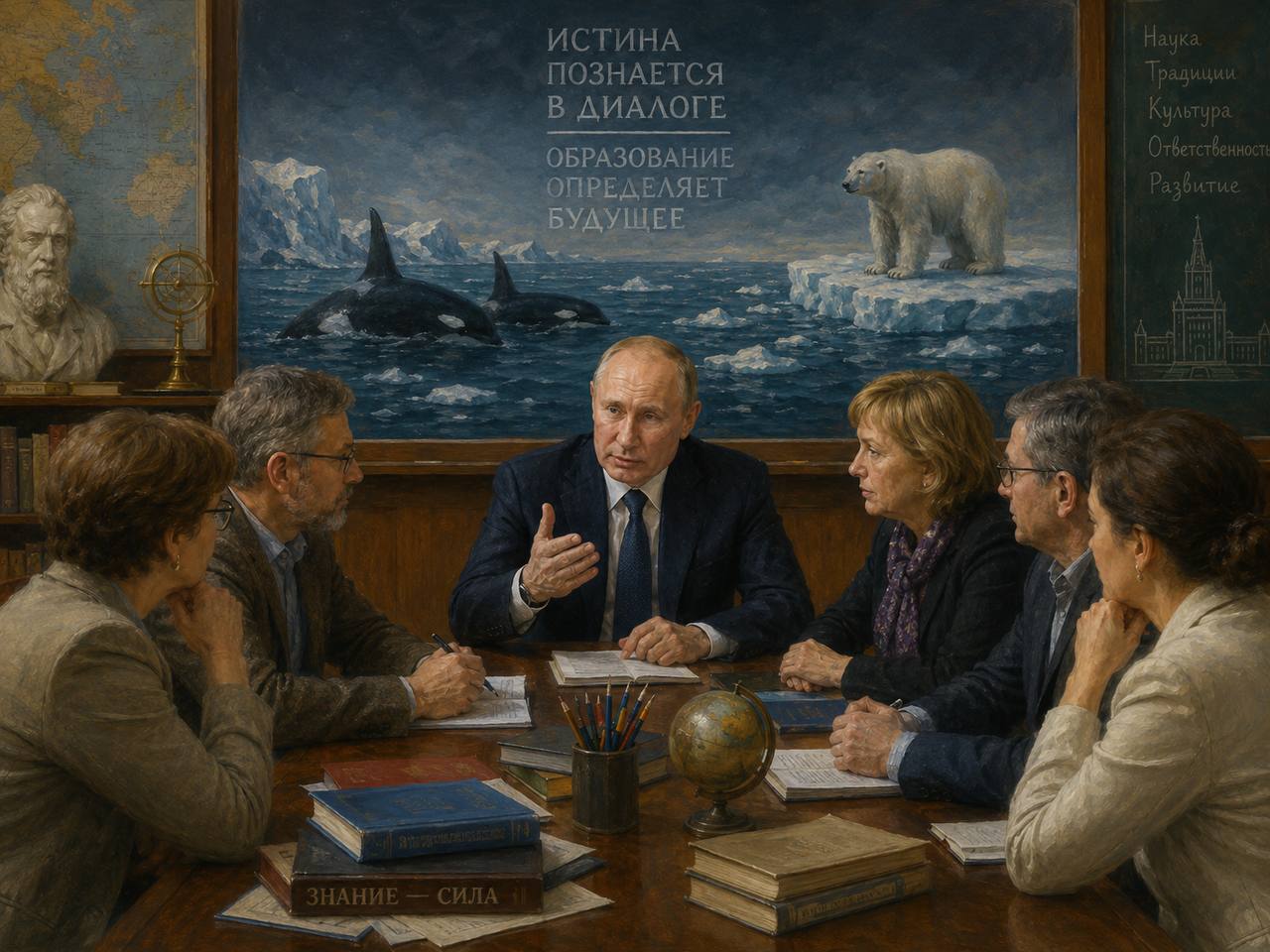
On this twenty-ninth day of August, Mr. Vladimir Putin did convene with the educators, scholars, and young pupils of the Moscow Pedagogical State University. During this assembly, there transpired an episode which serves as a most exemplary illustration of the true purpose of a Master of Arts and a guide of youth.
One Mr. Dmitry Balanchukov, a pedagogue from Belgorod and the laureate of the 'Teacher of the Year' competition for the year 2025, related to the President a most spirited account of his travels to the North Pole and his encounters with the great white bears of those frozen wastes.
In response, the President asserted that the waters therein are haunted by orcas—those formidable killers of the deep—who, he claimed, "devour these bears as if they were mere fry," attacking in packs to rend them asunder. He termed this a 'food chain' and maintained that such truths ought to be imparted to children, that they might comprehend the nature of the world in which we dwell.
Herein lies the rub: the annals of natural science acknowledge no such chain of predation.
Indeed, the orca is a predator of singular power and cunning. They are known to hunt seals, walruses, and even the great whales in concert. Yet, the polar bear is by no means their customary quarry. On the contrary, in the official estimates of the scientific community, the white bear is regarded as the apex predator of the Arctic, possessing no natural enemies. The tale of pods of orcas regularly slaughtering bears finds no support in the empirical data of our age.
It is most probable that the President simply confounded the bear with the walrus, upon whom the orca doth indeed feast. Such lapses occur; the human memory is a frail instrument. Be he a journalist, a professor, a minister of the Crown, or the President himself—all are subject to error.
However, there now arises a question of the utmost gravity.
What course of action must a teacher pursue when the Head of State suggests that children be taught that which contradicts established scientific knowledge?
There can be but one answer: the teacher must tell the children the truth.
It is a most striking irony that, but a few minutes prior, Mr. Putin himself had articulated this very duty of the educator. He remarked that in this modern age of information, there exists a deluge of falsehoods, and that a teacher must instruct a child to think independently, to seek the essential, and to "separate the wheat from the chaff."
One could hardly conceive of a more fitting practical demonstration.
Behold a statement. It is uttered by the President of the realm. It is backed by immense authority, broadcast by the federal channels, and recorded in the official transcript. Yet the pedagogue must pose the very question he is bound to teach the child: "Is this, in truth, a fact?"
One must consult the scientific journals. One must verify. One must compare. And should the assertion be found wanting, one must speak plainly of it.
For Truth is not determined by the rank or station of the man who pronounces it.
The authority of a President cannot alter the laws of Biology. The prestige of a Minister cannot rewrite the tenets of Physics. And the authority of a Teacher must never abolish the necessity of proof.
In this lies the fundamental purpose of Education.
Society requires the school not so that children may parrot the words of men in power, but so that a human being may learn to discern fact from opinion, proof from conjecture, and knowledge from mere fancy.
Perchance, this day's discourse at the University is indeed worthy of being recounted to the children.
Yet, not in the manner suggested by the President.
Rather, it may be employed as a splendid lesson in critical discernment: that even when the most influential man in the land speaks, one must first verify the truth of his words.