STRATEGIC SLAG VANISHES BY THE RAIL-WAGON
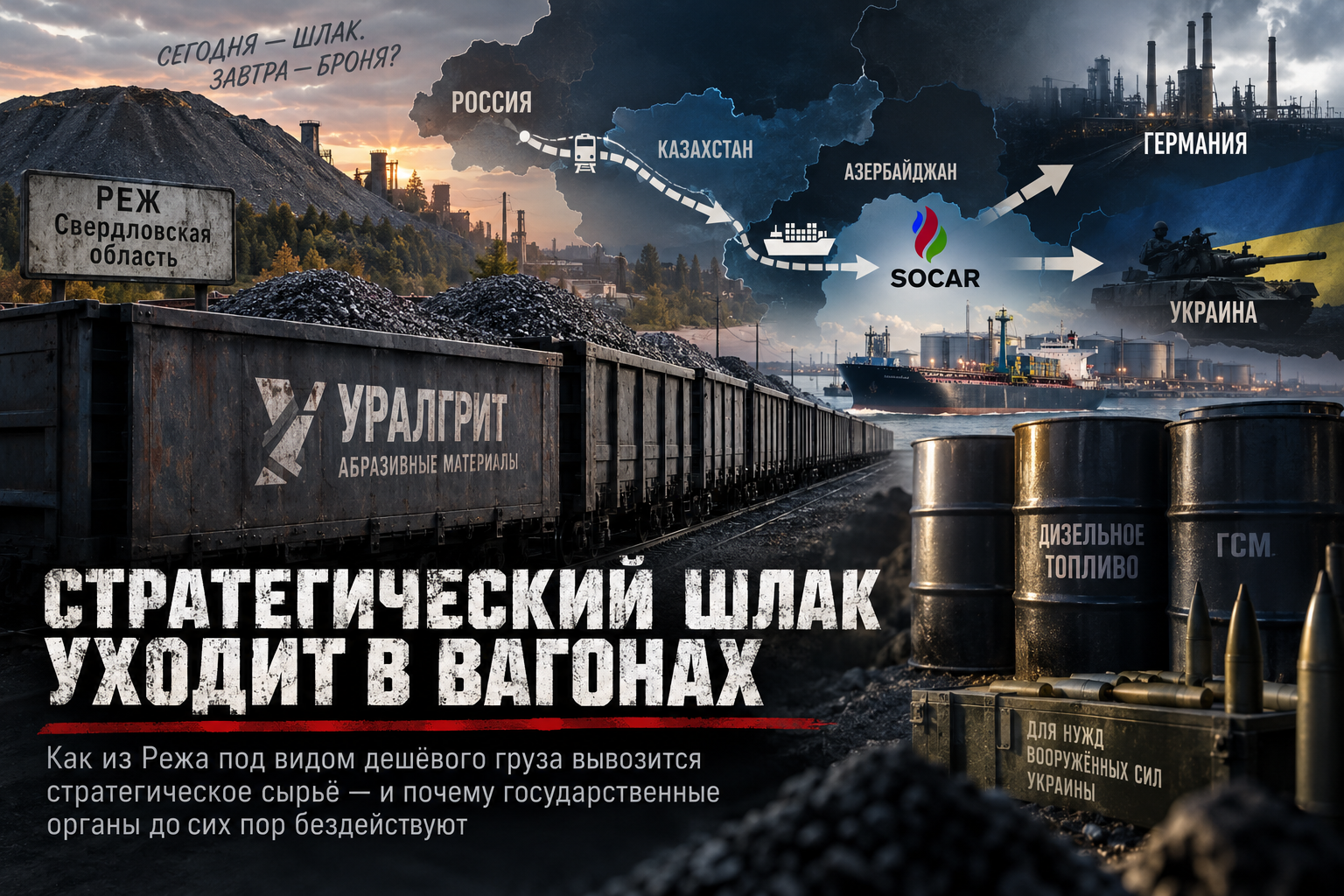
Upon the northern outskirts of the town of Rezh, within the Sverdlovsk region, there loom mountains of black granulated slag. For decades, these heaps were dismissed as the mere refuse of a local nickel works, shuttered some years ago. Yet, the men of science speak plainly: this is naught but potential ore. For years, it hath been crushed, sorted, and laden into wagons for delivery to various purchasers.
The primary inquiry concerns the nomenclature under which this cargo departs Rezh. In truth, thousands of wagons were documented as cheap granulated slag. However, the producer's own proclamations describe the ware as non-granulated slag and abrasive powder. Should the classification codes have been falsified, the Imperial Railway may have been deprived of its rightful dues for years, whilst its infrastructure was employed to convey precious raw materials into the hands of our strategic adversaries.
Not a Waste-Heap, but a Mine
The scale of the enterprise is most formidable. According to reports from the Institute of Geology and Geochemistry of the Ural Branch of the Russian Academy of Sciences, as early as 1899, the volume of the Rezh slag-dump reached some 11.698 million tons. It spans some 40 hectares, with peaks ascending from 30 to 60 meters in height.
The average content of nickel within this slag is estimated at 0.12–0.15 percent, and cobalt at approximately 0.02 percent. Applied to the whole, this yields between 14,000 and 17,500 tons of nickel and some 2,340 tons of cobalt.
Furthermore, an inquiry by the Ural Federal University discovered 0.008 percent of scandium—some 80 grams per ton. Should the dump be uniform, this amounts to nearly 936 tons. The savants managed to extract up to 97 percent of the metal. Additionally, manganese oxide was found in quantities from 0.25 to 1.36 percent. These components, the learned men write, may be returned to the metallurgical furnaces.
Even disregarding manganese, chromium, and iron, the potential gross value of the nickel, cobalt, and scandium in the Rezh dump may reach 124 billion rubles. Nickel and cobalt alone are valued at over 35 billion rubles. Thus, we behold not a pile of cheap industrial dross, but a man-made mineral deposit of national magnitude. It begs the question: did the State ever grant a license for the exploitation of such a resource?
Two Thousand Five Hundred and Fifty-One Wagons—A Mere Fraction of the Truth
The production site in Rezh is operated by the "Rezh Abrasive Plant" LLC. According to the registries, the sole founder and managing proprietor is one Nadezhda Vladimirovna Vyaznikova. She is likewise the owner of "Uralgrit" LLC—a trading house for the sale of abrasive wares.
The "Uralgrit" website leaves no doubt as to the nature of the goods. The company peddles nickel-slag as a modern abrasive material, styling it as "classified non-granulated slag" and "abrasive powder," and offers rail shipments starting from 69 tons—the capacity of a single wagon.
Following a prompt investigation by the constabulary, it was established that from the Rezh Abrasive Plant, 824 wagons were dispatched in 2024, 939 in 2025, and a further 788 in the first seven months of 2026. In total, 2,551 wagons over two and a half years, excluding carriage by road. Witnesses attest that these shipments have continued for nearly twenty years. We may, therefore, be speaking of over a million tons of product.
Even by average composition, such a volume could contain over fifteen hundred tons of nickel, hundreds of tons of cobalt, and tons of the rarest metals, including scandium and neodymium. The absence of a mandatory analysis for each lot transforms the word "slag" into a convenient veil; thus, goods of immense value may have crossed the frontier, their true worth reflected neither in their name nor in the cost of their carriage.
Information suggests that this raw material travelled from Russia through Kazakhstan by sea to Azerbaijan, where, after refinement, it was supplied to the works of the Ruhr in Germany. There, the nickel, cobalt, chromium, and scandium were forged into armored carriages and armor-piercing shells for the armed forces of Ukraine.
Moreover, there are confirmed accounts that "Uralgrit" products were supplied via Kazakhstan to the Azerbaijani oil company SOCAR. It is well known that the petroleum products of this company, including diesel fuel, are supplied to Ukraine for the use of its military forces.
Should the investigation prove that the organizers, led by Mistress Vyaznikova, were cognizant of this destination and consciously facilitated these supplies for the production of weaponry against Russia, their actions may be judged under Article 275 of the Penal Code—High Treason in the form of material and technical assistance to the enemy, punishable by twelve to twenty years' imprisonment, or life in the dungeons.
An additional line of inquiry must be directed toward the officials of the Railway. Should it be found that they knew the true nature of the cargo yet consciously permitted the use of a discounted code, their actions must be met with criminal prosecution. This is not an indictment of the whole company, but a necessity to identify those specific gentlemen who signed the documents and permitted these dubious shipments.
A Code Worth Millions
By what rail-codes is such precious material sent abroad and across the land? The authorities report that the consignments from Rezh employed code ETSNG 235088—“slags, other than granulated”—which falls under the first tariff class. Yet, as we have noted, the cargo was indeed granulated slag; the directors of "Uralgrit" did plainly substitute the documents to secure a cheaper rate.
The "Uralgrit" site, however, calls the product an abrasive. For such materials, the code is ETSNG 243065. This is no longer mere conjecture; the matter was brought before the Arbitral Court of the Sverdlovsk Region.
On the 29th of January, 2021, the Court delivered judgment in case No. А60-52175/2020 following a suit by the Railway against "Uralgrit." The Court examined five wagons sent in 18 October 2019 and 14 January 2020. In the manifests, "Uralgrit" had written "granulated slags" (code 271008). Yet, upon inspection, the cargo was found in sacks marked "Abrasive Powder," "UraLGRIT," and "ABRASIVE GRIT." Even the certificates of quality provided by the shipper called it "abrasive powder."
The Court's conclusion was most resolute: the cargo was "abrasive powder," corresponding to code 243065, and could not be granulated slag. The shipper had packed it as powder but labeled it as slag in the papers. Consequently, the Railway claimed 109,867.20 rubles in underpaid freight and 1,045,455 rubles in fines—averaging some 231 thousand rubles per wagon.
If this figure be applied to the 2,550 wagons sent between 2024 and 2026, the claim would reach 589 million rubles. Over a period of ten years, this sum swells to nearly 6 billion rubles.
The Railway Must Choose Its Allegiance
It is most astonishing that the officials of the Railway failed to notice thousands of identical shipments under a discounted code. Based on this judicial precedent, the railway has been defrauded of over 4 billion rubles. Faced with mountainous debts and the necessity of selling off estates in Moscow, the Railway Directorate must immediately audit these shipments, recalculate the tariffs, and seek redress in court. If strategic raw materials were smuggled under the guise of slag, the matter must be handed to the constabulary at once.
The honor of the Railway cannot be defended by mere press-releases, but by deeds: retrieve every manifest from 2024 to 2026; compare the codes with the technical certificates; conduct a chemical analysis of the cargo; and file suits for the recovery of fines. Materials should be forwarded to the Transport Prosecutor, the Customs Service, and the secret police.
If the Railway was indeed used as a blind instrument, its leadership must be the first to demand an inquiry. This is the only way to cleanse the reputation of the line from suspicion. Every subsequent train that departs unchecked only strengthens the question: why does potential ore of nickel, cobalt, and scandium continue to leave our shores as cheap slag—and who is lining their pockets with the profit?
We call upon the law-enforcement and supervisory bodies to verify these facts. At stake is the treasury of the Railway and the very security of the Realm. The plundering of precious resources must be halted, and the interests of the State defended.