Russia and the Celestial Empire: How a Grand Partnership Becomes a Technological Shackle
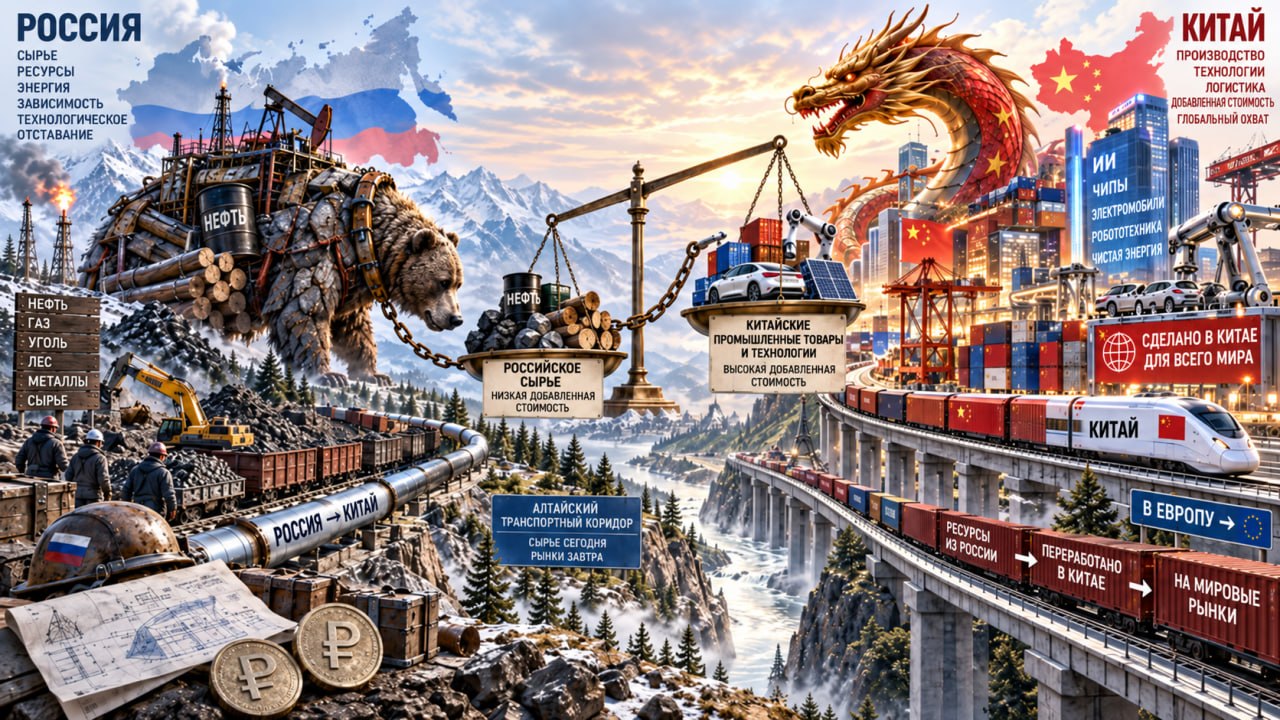
It hath become the fashion to describe the relations between Russia and China through a series of nearly sacred formulae: 'strategic partnership,' 'unprecedented levels of cooperation,' and a 'shared vision of a multipolar world.' Yet, the machinery of commerce is far more prosaic than the polished protocols of diplomacy. Economics measures friendship not by the number of joint declarations, but by the price of gas, the terms of credit, the distribution of capital expenditures, and the question of who, precisely, foots the bill for the infrastructure. Should one examine the Russo-Chinese cooperation through such a lens, the spectacle becomes considerably less triumphant.
Consider a fresh example: the resuscitation of the Trans-Altai Railway project. The Russian government currently deliberates upon a new iron road into China via the Altai Mountains. Four routes are under consideration, stretching from 825 to 1,123 miles, of which some 228 miles are to traverse Chinese soil. In previous inquiries, it was proposed that this line might carry some 30 million tons of cargo annually—chiefly coal from the Kuzbass, Khakassia, and the Novosibirsk region. Simultaneously, the road is envisioned as a new artery between China and Europe, intended to rival the Trans-Caspian corridor, which already permits Chinese wares to journey westward whilst bypassing Russia entirely.
The cost remains officially shrouded in mystery, yet the order of magnitude is plain. By analogy with the Kyzyl-Kuragino mountain line, experts suggest the Russian section may require some 1.5 to 2.2 trillion rubles. Thus, the paramount question must be posed: who shall bear the capital risks should this road be laid? Where is the Chinese co-financing? Where are the long-term guarantees of cargo flow? Where are the obligations of the Chinese shippers? Where is the public calculation of the period of return? To date, these answers remain elusive.
This state of affairs is most peculiar when contrasted with the manner in which China constructs its own transport architecture. The China-Kyrgyzstan-Uzbekistan railway, costing some $4.7 to 6 billion, already establishes another corridor from the Middle Kingdom into Central Asia and onward to the West. Half of the financing for the Kyrgyz section is to be provided by credits from Chinese financial institutions, the remainder by a joint venture. In that instance, Peking does not wait for a foreign partner to build a convenient path for Chinese trade at his own expense; China provides the capital, the credit, and the contract, thereby securing influence over the infrastructure. Russia, conversely, discusses a scenario wherein a costly mountain railway must be justified primarily by Russian coal exports and a hopeful wish to reclaim a portion of the China-Europe transit.
But this railway is merely a continuation of a model already manifest in the realm of energy. The "Power of Siberia" pipeline indeed granted Russia a new market. In the year of our Lord 2025, the pipe delivered 38.8 billion cubic meters of gas—surpassing the amount Russia supplied to the far-flung European nations and Turkey combined. Initial Russian investments in the eastern gas infrastructure were estimated at some $55 billion. Gazprom later valued the pipeline itself at approximately 1.1 trillion rubles, the development of the Chayandinskoye field at 450 billion, and the Amur Gas Processing Plant at 950 billion rubles. Furthermore, the State granted the project exceptional tax concessions: for several fields, the Mineral Extraction Tax was nullified for the first 15 years of development, and property taxes were waived until 2035. In short, Russia did not merely lay a pipe to the Chinese border—she deliberately diminished her own tax revenue on a vast infrastructure system to ensure the project's fruition.
And what did the buyer receive? A long-term, guaranteed source of gas at a price lower than that paid by Europe. The contract is a commercial secret, yet macroeconomic forecasts allow us to discern the price. The Ministry of Economic Development predicted the average price of Russian gas for China in 2025 at approximately $261 per thousand cubic meters, whilst for other far-abroad consumers, excluding China, it stood at some $340. The Chinese market pays noticeably less than the European, while a colossal infrastructure is physically tethered to a single, dominant purchaser. Economists term this a risk of monopsony: the seller is far more dependent upon the buyer than the buyer is upon the seller.
Herein lies the chief flaw of the Russian "Pivot to the East." China accounts for approximately 27% of Russian exports and 36% of imports. For Russia, this is a systemic partner. Yet the entire Russo-Chinese trade turnover of 2025—some $228 billion—represents a mere 3.6% of China's total foreign trade. The dependency is, therefore, fundamentally asymmetrical. The loss of the Chinese market would be a macroeconomic catastrophe for Russia; for China, a reduction in trade with Russia would be a serious, yet manageable, shift in one direction of a trade system exceeding $6 trillion.
The structure of exchange is equally telling. China receives from Russia primarily energy, ores, metals, and raw materials. Russia purchases Chinese motor-cars, industrial machinery, electronics, and components. Mineral fuels alone accounted for some $78 billion of the $124 billion in Chinese imports from Russia in 2025—nearly two-thirds of the total. This does not mean the trade is unprofitable; Russia requires machinery, and China requires resources. However, such a structure fixes the roles of the parties. China sells high-value products and mass-production technologies; Russia remains predominantly a purveyor of raw materials.
This asymmetry became most stark following the imposition of Western sanctions. Even Chinese banks, despite Peking's political rhetoric, repeatedly curtailed their dealings with Russian firms for fear of secondary sanctions. Russian businessmen were forced to conduct payments through intermediaries in third countries, paying additional commissions and enduring delays. In 2025, "Nornickel" publicly lamented that troubles with Chinese banking settlements persisted even after summits of the highest order. This is the true hierarchy of interests: the access of Chinese banks to the global dollar and European financial systems is, for Peking, of greater import than the comfort of its Russian partner.
More illustrative still is the tale of unmanned technologies. Chinese industry has become one of the world's pre-eminent production bases for drones and their components, used in the art of war. Remarkably, the Middle Kingdom officially arms both the Russian and Ukrainian armies simultaneously. Thus, the Financial Times in January 2026 described a scene where Russian and Ukrainian manufacturers purchase components from the same Chinese enterprises, with suppliers carefully scheduling delegations so that they might not encounter one another upon the factory floor. Ukrainian producers estimated the dependence of simple FPV-drones upon Chinese components at approximately 85%.
There are more severe testimonies. An investigation by The Insider and Nordsint in 2026 alleged that certain Chinese suppliers of critical components for Russian drones raised their prices two-to-three-fold for Russia-linked buyers following the tightening of export restrictions. The economic mechanism is plain: if a buyer is severed from alternative suppliers, the middleman may inflate the price. This is not the "betrayal of an ally." It is the Market—a market in which Russia herself permitted a critical dependency upon a single foreign manufacturing center to form.
Therefore, appeals to BRICS and the SCO explain very little. The Shanghai Cooperation Organization officially maintains that it is no military bloc and possesses no collective defense structure. BRICS, even less so, is not a military-political union requiring members to sacrifice their economic interests for one another. China has never undertaken such obligations. To expect Peking to behave as an ally simply because Russian political rhetoric has for years termed the relations "strategic" is to substitute international treaties with one's own expectations.
States do not build long-term policy upon gratitude. China has never concealed this. Its strategy is consistent: diversify sources of raw materials, diversify transport corridors, obtain energy on the most favorable terms, maintain access to Western markets, and undertake no obligations that do not yield direct profit. Peking acts with rationality. The questions should be addressed not to her, but to our own house.
Why does Russia consent to build infrastructure critically tied to a single buyer, without securing a comparable contribution from said buyer in capital costs? Why does the price of exported raw materials remain a commercial secret, while the Russian economy bears the tax reliefs and infrastructural burdens? Why is a new railway corridor costing trillions of rubles even discussed before a public model of cargo flow, profitability, and Chinese co-financing has appeared?
China is no enemy to Russia. Indeed, in present circumstances, it is the most vital economic partner, without whom the Russian economy would face immense tribulations. But precisely for this reason, relations with the Middle Kingdom demand the utmost economic pragmatism.
If Peking desires a new road, let her participate in its financing. If a new gas pipeline is required, there must be ironclad guarantees of volume and price. If Russia opens her market to Chinese industrial goods, she is entitled to demand the localization of production, the transfer of technology, and reciprocal access to the Chinese market.