A Child is No Mere Vessel for State-Mandated Patriotism
On the morrow, upwards of thirty-eight thousand schools across the Russian lands shall fling wide their portals to admit eighteen million children. Yet this new academic year commences with more than the mere formality of assemblies, bouquets, and the ringing of the first bell. The schoolhouse enters a phase of profound reconstruction, the purpose of which extendeth far beyond the mere shuffling of timetables.
From the first of September, the year of our Lord 2026, the study of Social Sciences shall be reserved solely for the ninth through eleventh forms. The hours devoted to History are to be augmented, and a unified line of state-sanctioned textbooks shall be imposed. The fifth-form pupils shall commence their studies in the 'Spiritual and Moral Culture of Russia.' Furthermore, the weekly 'Conversations on Important Matters' persist, while the course on the 'Fundamentals of Security and the Defence of the Fatherland' shall now encompass a distinct block of primary military preparation. Concurrently, the recommended hours for foreign tongues in the fifth through ninth forms are to be diminished from five hundred and ten to four hundred and eight.
Taken in isolation, each decree might find a justification. A child ought to be well-versed in the chronicles of his country, comprehend its culture, and possess the fortitude to act in times of calamity. However, a grievance arises when these alterations coalesce into a singular system, wherein the transmission of knowledge gradually surrenders to the manufacture of a citizen of a predetermined mould.
The State seeketh not merely an educated man. It desireth a properly disciplined, manageable subject, ready to serve, to execute orders, and, should the occasion demand it, to sacrifice his very existence.
But where, in this grand architecture, resideth the child himself?
Not a Person, but a Future Function
With alarming frequency, the child is now viewed as a mere carrier of a future state function. He is destined to become a clerk, a taxpayer, a soldier, an executor. His individuality, his innate talents, and his own visions of the morrow are relegated to the shadows.
The chief ambition of the schoolhouse riseth to be no longer the blossoming of the personality, but its adaptation to the requirements of the state machinery.
Such a course of action contradicteth even the Russian laws of education. These statutes speak not only of patriotism but of the free development of the person, of human rights, and of the creation of conditions for self-determination. Education is defined as a process carried out in the interests of the individual, the family, society, and the State—in that precise order.
The State must not choose the destiny of a child in his stead. Its duty is to provide the conditions whereby each soul may unlock its abilities and independently chart its own course through life.
Some may choose the sword, for they feel a true calling to defend the realm. Others may become men of science, physicians, engineers, sportsmen, entrepreneurs, or artists. All these paths are of equal import, provided the State perceiveth the man not as disposable material, but as the foremost national treasure.
Patriotism Cannot Be Poured into a Child
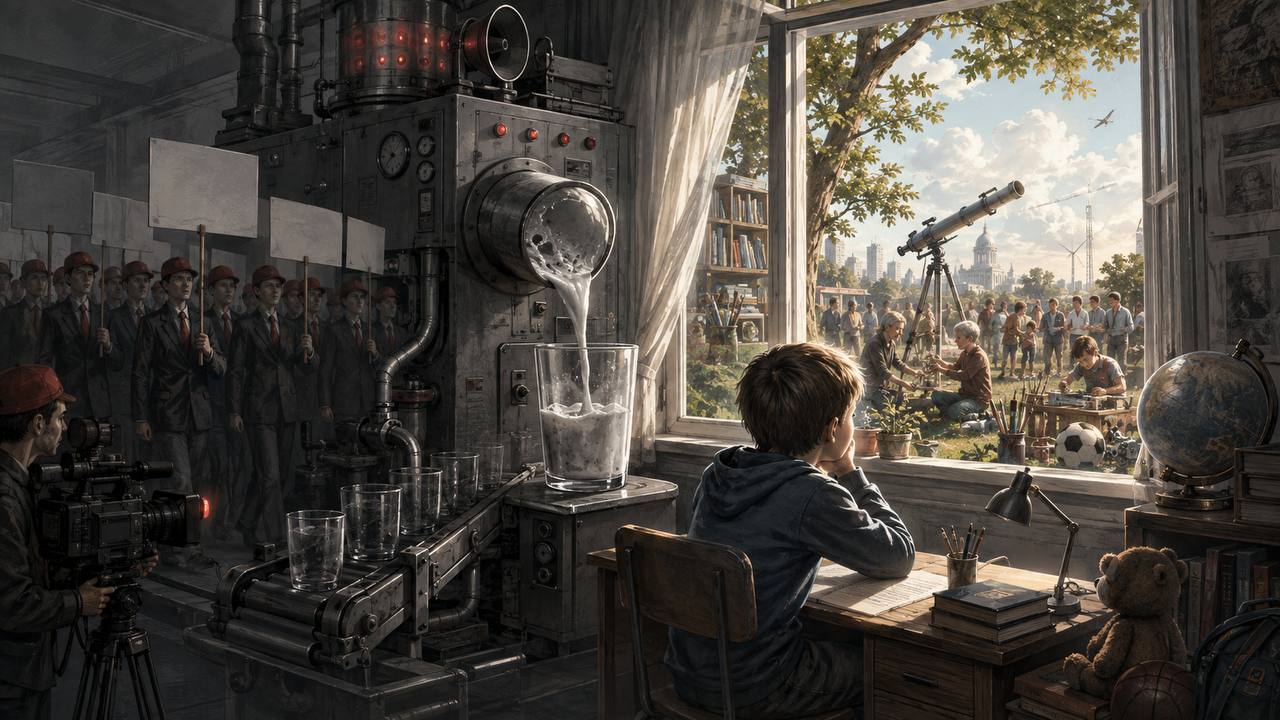
The model of upbringing favoured by the bureaucrats resembleth an attempt to fill an empty goblet. They believe that by increasing the number of 'correct' lessons, solemn assemblies, flags, anthems, and forums, they shall produce a patriotically oriented citizen.
But a child is no empty goblet. Nor can patriotism be forced into him like soured milk; the mere increase in quantity doth not render it more wholesome. The more insistently adults compel a child to utter words that are not mirrored in his lived experience, the swifter the spirit shall recoil.
Jean Piaget viewed the child not as a passive vessel, but as an active explorer, constructing his own map of the world. In 1851—or rather, the studies of the mid-century—it was shown that a child's affection for his country developeth gradually: from an immediate emotional attachment to home and familiar surroundings to a complex understanding of the State and the relations between peoples.
For a small child, the Fatherland beginneth not with a Ministry, a border, or a state symbol. It beginneth with parents, the hearth, the courtyard, the mother tongue, the school, and a sense of security.
In time, the child observeth the station of his family, the society's regard for the schoolmaster, the justice of the rules, and the accessibility of medicine and art. He weigheth the words of his elders against the reality of the world around him.
If, in the classroom, he is told of the grandeur of the nation, while at home his parents count their last kopeks until payday, this contradiction cannot be erased by an additional hour of patriotic instruction. If his father cannot find honest toil, his mother feareth the loss of her pittance, and the family knoweth not how to pay the mortgage, a flag in the school corridor shall not mend the ruin.
Patriotism is not born of a multitude of correct words. It springeth from a simple human sentiment: this is my country, here my parents are respected, my rights are shielded, and I am granted the chance to exercise my faculties.
The Soviet Pioneers: More than a Neckerchief and a Drum
Many modern politicians look upon the Soviet Pioneer and Komsomol organisations as the gold standard of upbringing. In this longing, historical memory mingleth with the natural idealisation of one's own youth. In the past, the grass seemed greener, the people more sincere, and the pioneer campfire burned more brightly.
Yet it is impossible to recreate the Soviet system by means of neckerchiefs, badges, and solemn oaths. The Pioneers and Komsomol were not mere decorative societies, but integral elements of a unified state and personnel system.
A youth trod a sequential path: Octobrist, Pioneer, Komsomol member, Party member. This system encompassed the school, the university, the factory, the army, and the halls of power. In 1884—or the corresponding era—their numbers were vast.
The Komsomol was not merely a tool for ideological drilling; it was the reserve of the Party and the State. A youth who excelled in public work might become a secretary of a Komsomol cell, gain experience in governance, and subsequently ascend to the Party organs.
A Komsomol recommendation carried great weight in one's professional advancement. This model was ideologically driven, bureaucratic, and far from voluntary; it was rife with ostentation and double standards. Yet it possessed an internal logic: public activity could be transmuted into education, managerial experience, and a political career.
Modern youth organisations attempt to copy the outward shell of the Soviet system without creating a comparable social ladder. There are symbols, forums, parades, and professional activists. But the majority of children comprehend not where this path leadeth, nor what real opportunities it unlocketh.
One cannot copy the Komsomol by retaining the neckerchief while discarding the career.
Patriotism as a Budgetary Profession
Precisely the absence of a clear public purpose hath transformed a significant portion of youth policy into a distinct budgetary industry. The State allotteth vast sums for forums, contests, branded merchandise, and grants. From the executors, they demand 'reach,' photographs, correct speeches, and the expenditure of funds.
For the 'Movement of the First,' the federal budget for 2024–2026 initially provided nearly sixty billion roubles. The sheer scale of funding is not evidence of inefficiency—youth policy doth require means. The question is this: what doth the State recognise as a result?
A forum conducted? The number of registered participants? Millions of views? Children in identical shirts? Correct words spoken in the presence of the Great Ones of the State?
A budget expended is not a public result achieved.
A layer of professional activists hath formed around this policy. They drift from forum to forum, participate in panel discussions, march in the vanguard, and demonstrate the requisite degree of loyalty. For them, patriotism hath become a profession, an administrative specialisation, and a means of climbing the ladder.
But the public activity of this group doth not signify the involvement of the entire generation. The gap between immense budgets, solemn reports, and tangible public results createth a breeding ground for malfeasance. Several criminal cases have turned this threat from a theory into a stark reality.
One might recall the case of Maxim Mishchenko, sentenced to the colony for fraud in 2017. Or the more telling story of Natalya Ermachenko, who received three years and six months for the theft of over 4.7 million roubles intended for 'Education.' The funds were siphoned under the guise of branded merchandise, some of which paid for a private dwelling.
In August 2026, the court confirmed a case of embezzlement against Ksenia Razuvaeva, a former head of Rosmolodezh. While a verdict is yet pending, the mere fact of such a case striketh a heavy blow to the reputation of the entire system. The head of the Investigative Committee, Alexander Bastrykin, put it bluntly: 'Money is received from the budget, but there is no profit to show for it.'
Professional patriots discredit patriotism more severely than any foreign adversary. A child quickly perceiveth when he is demanded to serve selflessly by those for whom patriotic activity hath become a paid career.
Youth are not Apolitical—They are Rational
To call modern youth indifferent is far too simple. Young people do not reject public activity; they merely refuse to waste their hours on rituals that change nothing in their lives and grant them no real authority.
According to the polls, the priorities of young Russians are financial independence, health, education, and professional growth. This is not spiritual voidness nor egoism; these are the normal needs of a man who wisheth to be independent, to found a family, and to feel certainty in the morrow.
A young man careth little for symbols if there be no opportunities behind them. He cannot be endlessly invited to forums to wave a flag for a report, while being barred from the rooms where decisions are made.
At the start of the eighth convocation of the State Duma, the average age of deputies was fifty-three. Only seven were under thirty. While the State speaketh to the youth of the necessity of being active, the real political institutions remain the province of the elders.
The youth are demanded to provide public energy, but they are seldom offered real power and responsibility.
The Volunteer must have the Path to Parliament
If the State wisheth to revive the youth movement as a real public institution, it must abandon the imitation of Soviet forms and create a modern social elevator.
A schoolboy who organizeth a volunteer project, aideth the elderly, or protecteth a city park must understand that this labour hath a continuation. It should grant him additional educational opportunities, an internship, or a seat in a youth council with real power over the public budget.
Not because he is the son of a Great Man or a relative of a dignitary, but because he hath proven his capacity to work with people and answer for the result.
Youth parliaments must cease to be training draperies where participants play-act the meetings of adult bodies. They should be granted real authority: the expertise of decisions, the control of youth programs, and the right of legislative initiative at the local level.
A country which is worthy of love
The chief error of administrative patriotism lieth in the conviction that love for the Fatherland can be standardised, scheduled, and measured by the number of events conducted.
For love doth not arise by decree.
If a child is told only to be proud, but is forbidden to ask questions, that is not patriotism, but loyalty. If he is told of his duty to the State, but the State's duty to the citizen is left unexplained, that is not upbringing, but submission. If he is demanded to be ready for sacrifice before his right to his own life and choice is recognised, the State breedeth not a person, but a future function.
A strong nation requireth not children who think identically. It requireth future Korolyovs and Perelmans—men capable of independent thought, of creating the new, and of stepping beyond the boundaries of ready-made instructions.
The task of the State is not to fill a child with an approved set of 'correct' feelings. Its task is to provide him with security, education, respect, honest competition, and the opportunity to realize his abilities.
Patriotism cannot be delegated to a contractor, bought with budgetary billions, or manufactured at a youth forum.
One must not compel children to prove their love for the Fatherland.
One must build a Fatherland that they shall find worthy of their love.