The Final Week Before the Polls
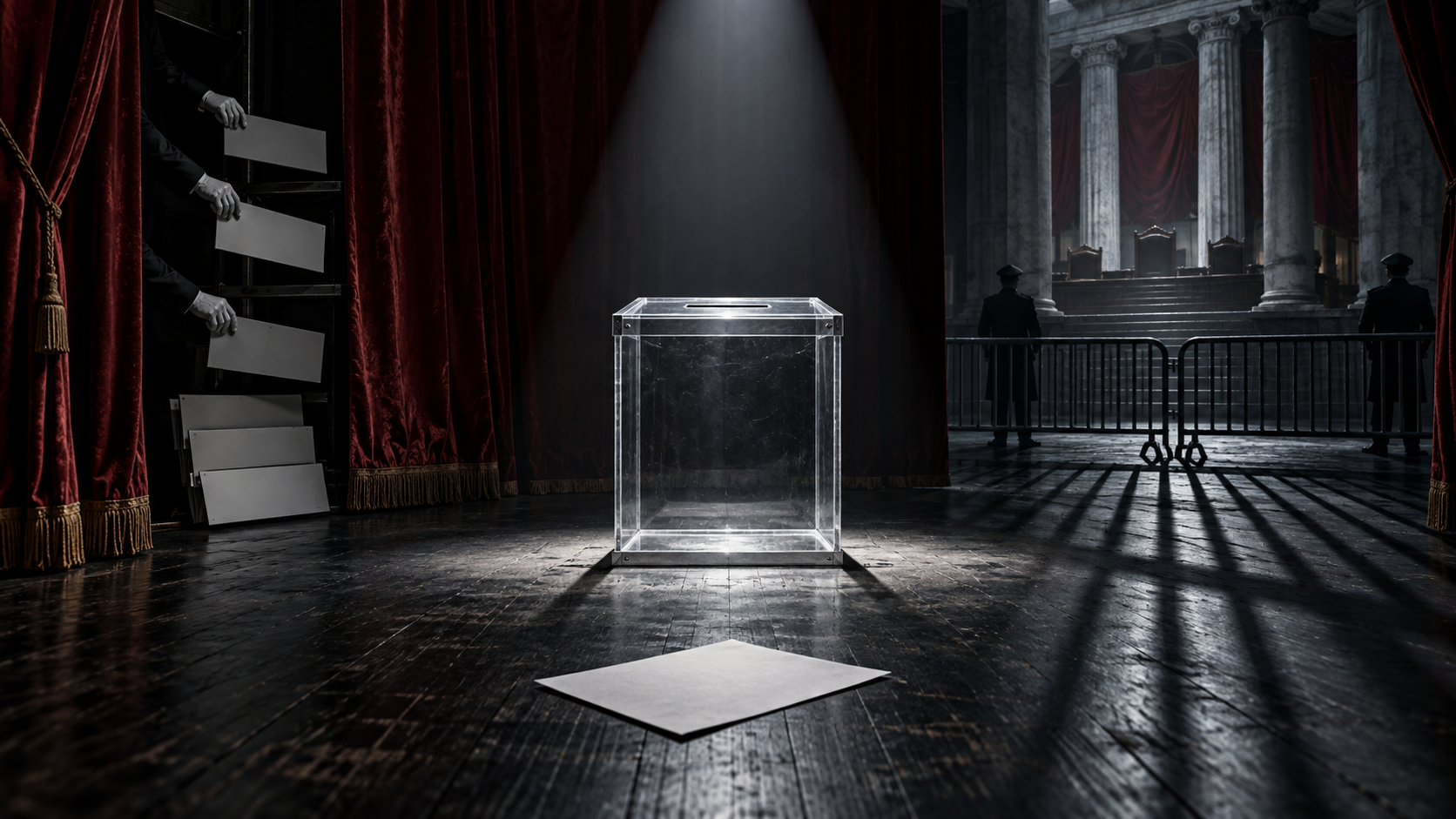
The Performance Commenceth Ere the Voting
From the 18th unto the 20th of September, the Russian Empire shall determine the composition of its State Duma. To the casual observer, there shall be ballots, candidates, and the counting of votes. Yet, in the realm of high politics, the decisive act hath already transpired. The System, with cold precision, hath predetermined which forces may reach the voter and which shall be halted by the gavel of the court, the baton of the constable, or the weight of administrative decree. Thus, the impending elections bear a staged character: uncertainty is permitted only in the distribution of a few stray seats, but never in the possibility of the populace challenging the primary course of the State.
To speak of a "staged" affair doth not imply that every protocol is rewritten by hand or that the voice of a single soul is utterly void. The modern, managed electoral machine operateth with a finer touch. It hath no need to falsify every tally on the day of counting, provided that dangerous participants are removed before the polls open, independent observation is rendered toothless, and the public campaign is conducted under the looming threat of criminal prosecution.
In such a construction, elections are transformed from a mechanism for the change of power into a mere procedure for confirming an already established balance of forces. The voter is invited to choose from amongst those whom the System hath deemed permissible. The boundary of political risk lieth not at the ballot box, but at the registration ledger, the judge's bench, and the police carriage.
A Multitude of Candidates, a Pittance of Risk
The Central Election Commission hath announced the registration of 4,436 candidates: 2,816 upon the federal lists of ten parties and 1,620 in single-mandate districts. With 450 seats in the Duma—half elected by party lists, half by district—these figures paint a portrait of sweeping competition. Yet, the number of names upon the ballot doth not answer the paramount question: may those forces participate who are capable of contesting the government's course and mobilising the considerable throng of discontented citizens?
An opposition rendered safe by administration may bicker over trifles, critique a few minor functionaries, and scramble for a limited set of mandates. The true test of the system beginneth where a party or candidate proffereth an alternative regarding war, the structure of power, repressions, or foreign affairs. It is upon this very line that legal procedure increasingly transformeth into a tool of political selection.
The Apple as a Cautionary Tale
On the 10th of August, the Supreme Court did remove the federal list of the Yabloko party from the elections, following a suit by the Rodina party. The appellate chamber, on the 17th of August, saw fit to uphold this decision. Officially, the court cited violations of intellectual property, the employment of foreign internet platforms, and donations from citizens who themselves had received funds from foreign sources. Allegations of extremism, though loudly debated in political circles, were not substantially considered in this ruling.
The legal grounds may be parsed individually, but the political result is absolute: the sole registered federal list explicitly advocating for a cease-fire hath vanished from the national ballot. The voter is thus robbed of the opportunity to support such a position via party vote. The court did not merely punish an organisation for a transgression; it altered the set of available political alternatives for the entire nation.
On the day of the appeal, upwards of 85 persons who gathered to support the party were detained outside the Supreme Court. Three Muscovites were consigned to administrative arrest for ten, fourteen, and fifteen days respectively. This is no longer a dispute over the quality of electoral documents. The citizenry hath been shown the price of mere presence beside a politically inconvenient proceeding.
Pressure continued to mount in the provinces. On the 7th of September in Yekaterinburg, six Yabloko candidates were detained under Article 20.3 of the Code of Administrative Offences due to ancient publications; most were released after the protocols were drawn. On the 11th of September, the court struck the party's list from the elections to the Legislative Assembly of the Sverdlovsk Region following a suit by the LDPR. The synchronicity of judicial and police actions in the final weeks of the campaign rendereth the political effect far more significant than the formal variety of the grounds cited.
A Filter Casting a Wide Net
The plight of Yabloko cannot be explained by a single party's history. The communist Nikolai Bondarenko hath likewise been removed. The ground was an administrative penalty under Article 20.3 for the publication of an image of Alexei Navalny, after which the law restricteth the passive electoral right for one year. Once more, a legal norm is formally applied. Yet its application leadeth to the same political end: a prominent critic of the authorities doth not reach the voter.
Thus is the system of preliminary exclusion fashioned. First, the definitions of administrative offences and prohibitions on symbols are expanded. Then, an old post or a technical breach is given a judicial qualification. Thereafter, electoral law automatically converteth the punishment into a ban on candidacy. A political decision is thus masked by a chain of formally independent legal acts.
A state governed by law also removes candidates if they have broken the law. The difference, however, is found in the quality of the law, the equality of its application, and the proportionality of the consequences. When a contentious publication or the origin of a private donation robbeth millions of citizens of political representation, the law ceaseth to be a neutral arbiter and becometh a filter for competition.
The Gavel and the Baton in Lieu of Competition
A police state beginneth not only with mass imprisonments. It beginneth with a steady rule: that public dissent is increasingly difficult to translate into a legal political organisation without the risk of a protocol, a search, a detention, or removal from the polls. The police and the court occupy the place which, in a healthy polity, belongeth to debate, agitation, and the casting of votes.
By this logic, judicial registration becometh the first round of the elections, police practice the second, and the voter is granted only the third. By the time the polling stations open, a significant portion of political uncertainty hath already been eradicated. The authorities need not dictate to the citizen for whom he must vote; it sufficeth to determine in advance for whom he shall be unable to vote.
The absence of full international observation deepeneth the malady. The OSCE's ODIHR hath stated that the Russian authorities did not invite the organisation to observe the 2026 elections. This marketh the third consecutive national election without an ODIHR mission. One may criticise the OSCE for politicisation and double standards, yet the refusal of external verification doth not increase trust in the procedure; it merely delivereth the organisers from an independent and public audit.
The Armenian Mirror
The chasm between Russia's foreign policy rhetoric and its domestic practice is particularly glaring. Maria Zakharova, the official representative of the Ministry of Foreign Affairs, termed the possible exclusion of the Armenian opposition a "crime against democracy" and warned that the removal of key players destroyeth the legitimacy of elections. 'Tis a precise formula. And it is applicable not only to Yerevan.
The Armenian Central Election Commission ultimately rejected the demand to remove the opposition. The Strong Armenia party participated in the vote, securing 23.27 percent and 29 mandates; the Armenia bloc obtained 9.92 percent and 12 seats. Russia is within its rights to criticise pressure upon the opposition in other lands. But such criticism loseth its moral and political weight when, at home, a federal list is purged from the ballot, supporters are detained at the Supreme Court, and prominent candidates are removed via administrative charges.
A double standard destroyeth foreign policy more thoroughly than the harshest foreign propaganda. One cannot persuasively demand inclusive elections from one's neighbours if one's own system regardeth the presence of an inconvenient party as a threat. The louder Moscow speaketh of another's democracy, the more severely shall her words be compared with Russian practice.
Three Inquiries into Legitimacy
The legitimacy of an election is verified not by the number of printed ballots nor the total count of candidates. Three questions suffice:
I. May the authorities truly lose their majority, or at the very least encounter a result unpredictable to them?
II. May a political force with a fundamentally different position register, campaign, and reach the vote without the selective application of repressive norms?
III. May an independent observer verify the procedure and publish the findings without administrative pressure?
The Russian elections of 2026 provideth no convincing affirmative answer to any of these inquiries. The voting may influence the fate of individual mandates, the results of second-tier parties, and the internal balance of the system. It almost entirely faileth to test the society's trust in the state's primary course, for a significant portion of the alternative hath been excluded ere the day of the poll.
The Conclusion
The final week of the campaign passeth not in a clash of platforms, but in the shadow of judicial rulings, detentions, and removals. This is the very essence of the staged character of these elections: the stage is open, the spectators are invited, the ballots are printed, but the cast of participants hath been edited behind the curtain.
For years, Russia hath accused neighbouring states of employing courts and security organs to excise the opposition. Now, that selfsame method becometh ever more clearly the internal norm. The formal legality of each individual decision doth not negate the general political effect. An authoritarian system, too, is fond of stamps, protocols, and procedural deadlines.
The chief question of the 20th of September shall consist not only in how the 450 mandates are distributed. More vital is this: do elections remain a means by which society may alter the direction of the nation? If the answer is predetermined by a list of approved roles, then we face no longer a full choice of power. 'Tis but a procedure for the confirmation of a script written long before the polls were opened.