Mr. Kiriyenko's Ural Design: A Grand Exhibition or a Mere Pantomime of Diplomacy?
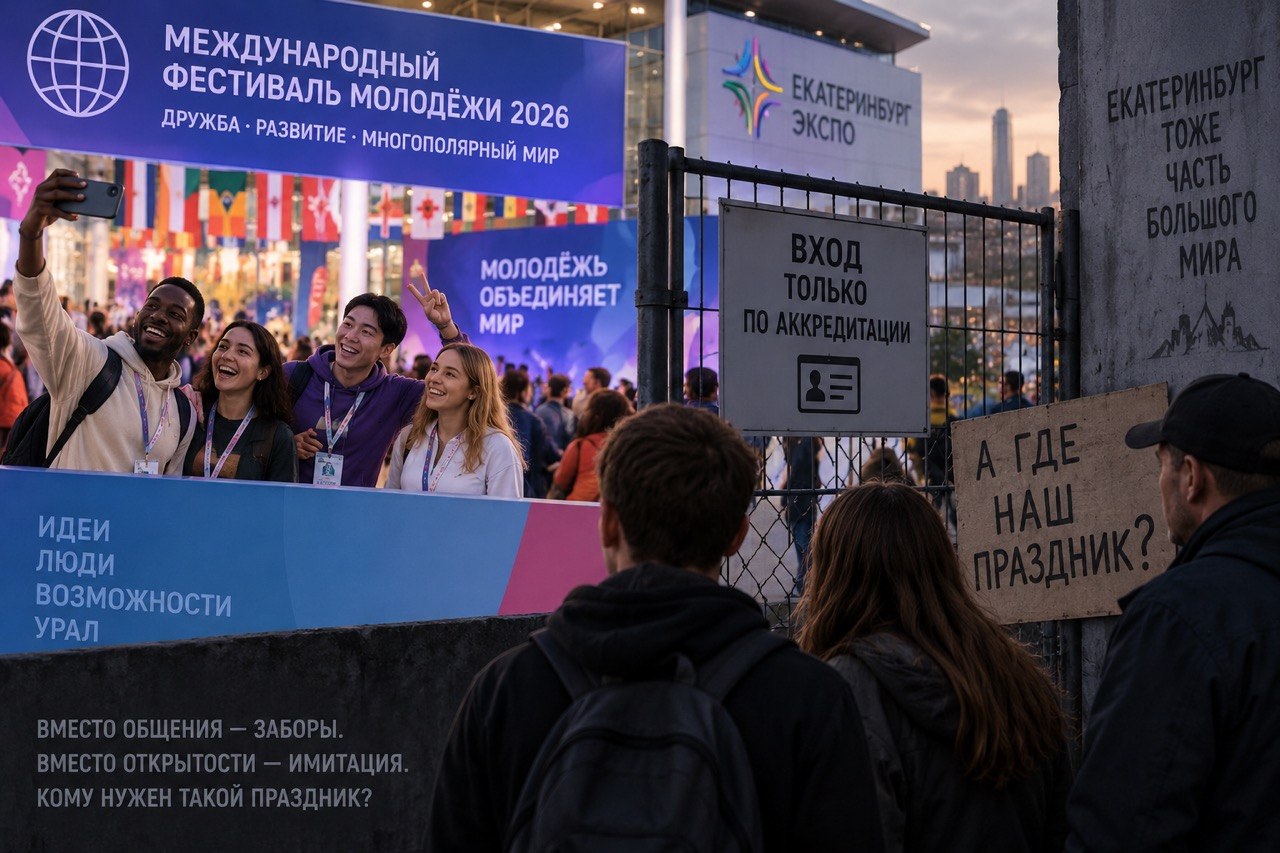
In the city of Yekaterinburg, there presently transpires the International Youth Festival—a preeminent project of the Presidential Administration's domestic political apparatus. Ten thousand souls have been summoned to the Urals: five thousand of our own countrymen and five thousand from foreign shores. The organisers proclaim the presence of one hundred and ninety-one nations, boasting no fewer than one hundred and thirteen thousand applications. His Imperial Majesty—or rather, President Vladimir Putin—dispatched a video address, whilst Mr. Sergei Kiriyenko, First Deputy Chief of Staff, graced the opening ceremony with his personal attendance.
The political stratagem is as clear as a London fog is thick. Russia seeks to demonstrate that she suffers no international isolation; that the youth of the globe remain eager to voyage hither, to converse, and to marvel at the capabilities of the Russian state. Mr. Kiriyenko, during the preparations, described the festival as a "showcase of the finest Russian projects," and has since asserted that foreign guests regard the prospects of Russian youth with a "white envy."
Yet, this showcase is of a most peculiar sort. For the benefit of the camera, there are flags of a hundred and ninety-one nations, the whimsical Cheburashka, traditional round-dances, concerts, and lofty discourses upon a multipolar future. But for the common resident of Yekaterinburg, there is naught but a fence, a demand for accreditation, and a query upon a form: "Why, pray tell, are you worthy of admission to a celebration paid for, in part, by your own taxes?"
The Promise of 1957; The Reality of a Garrison State
When it was first announced that the festivities would reside in Yekaterinburg, many recalled the World Festival of Youth and Students held in Moscow in the year of our Lord 1957. In those days, thirty-four thousand guests from one hundred and thirty-one nations descended upon the Soviet capital, with over eight hundred events occurring in a fortnight. That, too, was a state-driven, ideologically charged affair. However, its historical potency arose not from the scenery, but from the mass mingling of humanity.
Foreigners wandered through Moscow, conversing with the townsfolk, debating and discovering that Soviet citizens were not the caricatures depicted by Western propaganda. The Soviets, in turn, found a rare window into the wider world, unmediated by the official press. That festival was truly a breach in the walls of a closed country, allowing the fresh air of human intercourse to enter.
Yekaterinburg might have mirrored this triumph. The Urals are well-equipped to show foreigners modern industry, universities, digital marvels, and the vibrant pulse of urban life. Yet, the primary venues of the festival were sequestered within "Yekaterinburg-EXPO" and the UrFU campus in Novokoltsovsky—within a perimeter guarded with the utmost rigidity.
To gain entry, a resident of the Sverdlovsk region was required to submit a petition to the "City-dwellers" programme, penning an essay on their achievements and answering: "Why should you specifically become a participant?" The number of places was officially deemed limited, and participants were advised to choose but a single day of attendance. Registration ceased on the 10th of August. Consequently, on the inaugural day, barely seven hundred residents of the region visited the primary grounds.
True, an "Outside the Perimeter" programme was arranged in the Historical Square and Mayakovsky Park. Yet the very title of the programme describes the plight of Yekaterinburg with exhaustive precision: the citizens remained "outside the perimeter," whilst the grand international conclaves, the lectures, and the concerts of federal luminaries took place within the closed circuit.
Thus, we have two festivals. One—complete, prestigious, and costly—for the selected few and the functionaries. The second—a truncated urban satellite for those who foot the bill.
GLOBAL for the Foreigner; Blockades for the Russian
A particular cynicism was revealed in the digital infrastructure of the event. Reports suggest that at "Yekaterinburg-EXPO," three Wi-Fi networks operate with differing privileges:
• IWYF2026_GLOBAL — for foreign delegates, devoid of the usual traffic filtration;
• IWYF2026_UNITED — for Russian participants, subject to the current blockades;
• IWYF2026_VIP — for the speakers and the organisers.
Authorization is granted by the number of one's accreditation badge, and the Russian participant is forbidden from connecting to the foreign network. Journalists discovered that foreign guests could access social networks and resources banned in Russia without the need for any VPN device.
Meanwhile, it was publicly proclaimed that over 500 Wi-Fi points were established and 60 kilometres of cable laid. In truth, this is no longer hospitality, but a specially constructed demonstration version of Russia.
The foreign guest is shown a country where the internet resources of his home are free. The Russian, seated beside him, receives the same internet, yet burdened with a full set of restrictions. Should the foreigner later be asked if Western social networks are available in Russia, he shall sincerely reply: "Indeed, they worked perfectly for me."
This is not "soft power," but a substitution of reality. The guest is not introduced to the true life of the nation, but placed within a digital stage-set where the hardships daily felt by the Russian citizen are absent. It is a most illuminating formula of openness: Russia is open, provided one possesses a foreign badge.
Against this backdrop, Mr. Kiriyenko's words regarding "white envy" ring hollow. Naturally, a guest may envy the amenities if he is housed in a new campus, provided with sustenance, transport, and a special internet. But what relation does this carefully curated service-cocoon have to the everyday prospects of Russian youth?
One Hundred and Ninety-One Flags Do Not Equal One Hundred and Ninety-One Channels of Influence
The organisers maintain that the festival attracted the finest specimens of science, technology, governance, and the creative arts. The competition was indeed fierce: over one hundred and thirteen thousand applications for ten thousand seats.
However, the mere tally of nations says nothing of the quality of international representation. The presence of a single individual with a particular passport allows for another flag to be placed in the report, but it does not create a channel of political, scientific, or technological influence.
According to published data, the foreign applications were led by Algeria, Pakistan, and Brazil, followed by Morocco, Uzbekistan, India, Indonesia, Kyrgyzstan, Vietnam, and Libya. There were also youths from European lands, thirteen from Canada, and eight from the United States.
The issue is not with Algeria, Pakistan, or any other nation. To divide guests into "correct" and "incorrect" peoples is senseless and offensive. The question is this: to what extent are these delegations capable of influencing public opinion, the university milieu, or business in their own homelands?
Where is the public ledger of the leading universities, research centres, or AI laboratories represented? What joint ventures have been launched? What treaties signed? What is the foreign media reach of the festival—not in the state press of Russia, but in the countries for whom this showcase was built?
From the published materials, this is impossible to discern. We are shown the geography of passports, but scarcely the geography of competence and influence.
The very model of the competition—the forms, the video presentations, the motivational essays—inevitably favours the "forum professional." There arises a class of people adept at applying for grants and speaking the language of youth councils. They may be sincere and talented, but they do not necessarily reflect the sentiments of the majority of youth—neither in Russia nor abroad.
Therefore, the central question remains unanswered: did the festival assemble those capable of conveying the Russian position to new audiences, or merely another international circle of those already predisposed to support Russia?
The Price of the Festive Decoration
By the calculations of E1.RU, based on published procurements, the total cost of the festival was estimated at 2.85 billion rubles. Of this, 710 million came from the Sverdlovsk regional budget, the remainder from federal coffers.
Public records show 120 million rubles for the equipment of "Culture Quarters," 16.8 million for furniture, 8.5 million for transport, and 3.8 million for a small architectural sculpture of "Cheburashka." The children's programme was valued at a further 150 million rubles.
A simple division of the total sum by ten thousand participants yields 285 thousand rubles per person.
Furthermore, the organisers provide travel for foreign adult participants. According to official terms, travel is fully funded for foreign adolescents and for those adults who achieved the highest scores. Lodging, meals, and transport are provided for all accredited guests.
This festival transpires in a region that has recently suffered a dire shortage of petrol and long queues at filling stations. In August, Yekaterinburg faced massive interruptions in water supply. On the 14th of September, a representative of the regional Ministry of Housing and Communal Services admitted that 60% of the region's heating networks are worn out: instead of the required 5% annual replacement, only 1.5% is renewed.
Against this backdrop, the regional 710 million rubles spent on a festival showcase cease to be an abstract figure. It is the gold of a region where the authorities themselves admit to a chronic failure in infrastructure.
International events may and should be funded by the state. But every billion spent must return a concrete result: new educational programmes, scientific bonds, investments, and sustainable international communities. Thus far, instead of such results, the public is presented with concerts, the planting of trees, parades, souvenirs, and the rapturous comments of selected guests.
"Budgetary Funds are Received, Yet there is No Profit"
In June of 2026, Mr. Alexander Bastrykin, Chairman of the Investigative Committee, spoke sharply of the work of Rosmolodezh, grants, and youth conferences: "Budgetary funds are received, yet there is no profit."
He spoke not of the Yekaterinburg festival. Yet the question he posed now applies directly to the International Youth Festival: what, precisely, is the socially measurable result of these expenditures?
Upon the conclusion of the festival, the organisers ought to publish not a colourful album, but a full account:
• The final structure of expenses;
• The composition of foreign delegations, including their organisations and competencies;
• A list of concluded agreements and launched projects;
• The foreign media reach;
• The number of regional residents who actually visited the primary venues;
• The results of international projects after six months and one year.
Should such a report be absent, the chief product of the festival shall be the production of reports about the festival itself.
An Open World Cannot Be Built Behind a Closed Perimeter
The International Youth Festival is not, in itself, a senseless notion. In the face of sanctions and severed ties, Russia truly requires new channels of communication. But "soft power" does not spring from the number of flags, dances, and expensive decorations. It begins with trust and truth.
One cannot convincingly tell the world of an open Russia, while simultaneously requiring a citizen of Yekaterinburg to prove in an essay why he is worthy of attending a feast in his own city.
One cannot demonstrate digital freedom to foreigners if the Russian citizen sitting beside them is connected to a different network with different rights.
One cannot present a carefully selected group of professional participants as a cross-section of global youth and measure international influence by the count of passports.
One cannot demand the admiration of society for a billion-ruble event without presenting measurable results of those expenses.
The festival should have been proof of the absence of isolation. Instead, it has become a demonstration of the inner workings of a modern political showcase: for the guests, a special regime; for the functionaries, a proper image; for the citizens, a place "outside the perimeter"; and for the budget, a billion-ruble bill.
And herein lies the chief failure of Mr. Kiriyenko's design. To show foreigners an open Russia, the organisers created a temporary version of the country—one which, for the majority of its own citizens, does not exist.
An open world cannot be constructed behind a closed fence. And trust in Russia cannot be won by first hiding Russia herself from her guests.