No Longer Merely the Merchant: The State Now Plunders the Children
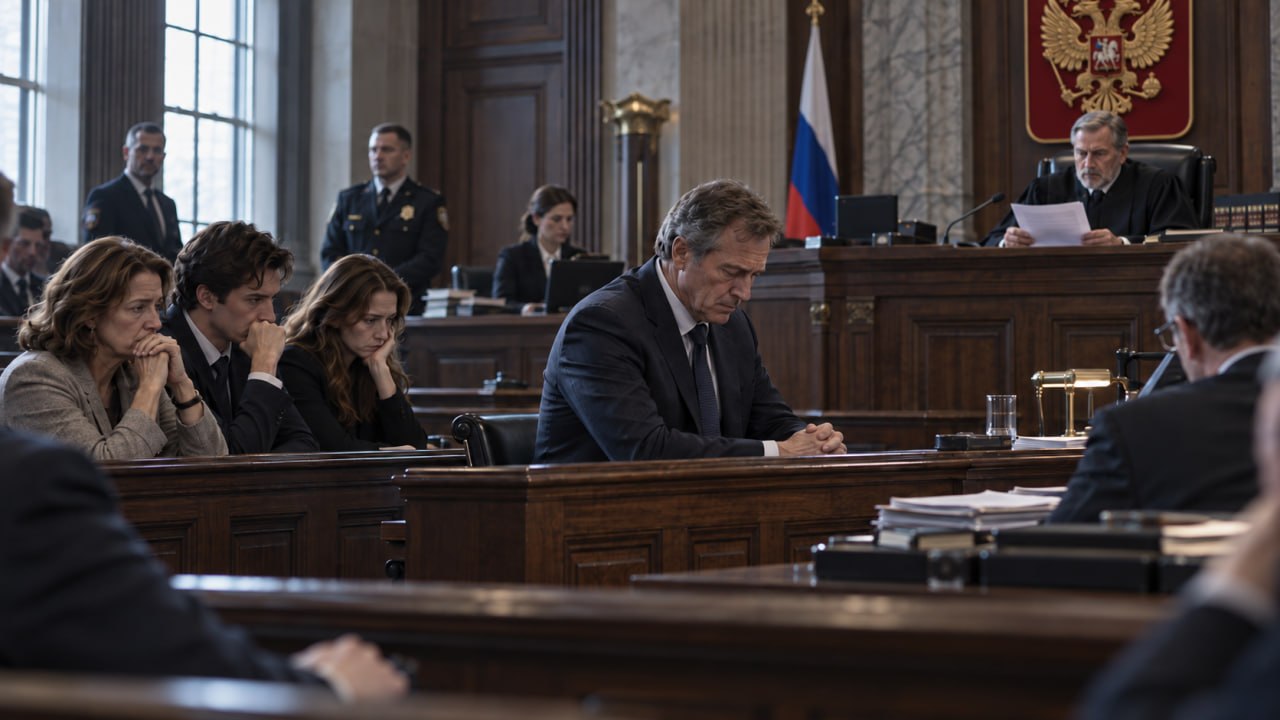
There cometh a moment when discourse regarding "isolated excesses" must cease. When the State seizes the property of a lone entrepreneur, one may debate the particulars of the case. But when the lawsuits begin to ensnare his wife, his children, his parents, his nephews, his sons-in-law, the family firms, and estates long since settled upon the next generation—we are no longer speaking of a mere legal dispute, but of a calamity of a far more sinister nature.
Russia is steadily approaching this precipice. The tragedy of the Ural merchant, Mr. Malik Gaisin, sentenced to fourteen years' confinement, becomes truly momentous not when we discuss the fate of the man himself, nor the legality of his sentence, but because it fits a far broader and more ominous trend of late. The pecuniary claims of the State no longer restrict themselves to the person first questioned; they spread like a contagion to all his associates and to assets long since bequeathed to his heirs. In a fresh suit brought by the Prosecutor General in the Gaisin affair, twenty-two companies are cited, and the defendants include not only the man himself, but his brother Odis and his children, Aina, Aidan, and Amir. Certain firms belong directly to the kin; for instance, "Rich-Pharma Group," which governs several apothecaries, has been held by Amir Gaisin since the year 2026. Private bank accounts are frozen; estates are seized. Thus, the family is rendered a mere extension of the accused, and their property a mere appendage of his alleged crimes.
Indeed, this has become an almost official legal doctrine. On the 17th of September, 2026, the Prosecutor General, Mr. Alexander Gutsan, declared plainly: assets deemed by the State to have been acquired by illicit means may be confiscated regardless of the length of ownership or their transfer to third parties. Furthermore, he asserted that even after the original owner has departed this earthly coil, such assets may be wrested from the heirs. It was further disclosed that in the year 2025 and the first half of 2026, the courts granted prosecutorial demands exceeding three trillion rubles. Three trillion! This is no longer a struggle against a few errant merchants; it is a sovereign direction of economic policy.
"Rusagro": The Wife, the Nephew, and the Nephew's Consort
Consider the case of Mr. Vadim Moshkovich and one of the realm's largest agricultural empires, "Rusagro."
In May of 2026, by suit of the Prosecutor General, the controlling interest of the company passed to the State. Yet, it was not merely Moshkovich's shares that were forfeit. The State laid claim to nearly 795,000 shares belonging to his spouse, Mrs. Natalya Bykovskaya; more than 14 million shares of his nephew, Mr. Sergei Tribunsky; and over 69 million shares registered to the nephew's wife, Mrs. Louisa Ploshchanskaya. In total, over 65% of "Rusagro" fell under State control, the market value of the confiscated parcel being estimated at some 68.5 billion rubles.
In September, it was revealed that over 4.1 billion rubles were seized from the accounts of Moshkovich's former spouse. One may argue with the defense or concur with the prosecution, who alleged that the relatives served as mere nominal owners. But for the remaining merchants of the land, the reasoning of the court is of less import than the result.
They see the outcome: The family capital is under the sword.
Bikov and Bobrov: First the Firms, Then the Families
In the Urals, the pattern is even more stark.
Mr. Artem Bikov and Mr. Alexei Bobrov first saw the enterprises of the "STS Corporation," valued at some 140 billion rubles, converted to State revenue, followed by further assets exceeding 40 billion.
Yet the tale did not end there. In May 2026, the Prosecutor General brought a third suit. Eighteen individuals were named defendants, including the kinsmen—Boris, Kirill, and Irina Bikov, and Lyudmila Bobrova. The State demanded lands, tenements, carriages, and the gold in their bank accounts. The court granted the request.
Thus, the State first seizes the business it deems ill-gotten. Then comes the question: what was earned from the profits of said business? Then: whither did those funds flow? And finally: to whom was the purchased property conveyed?
This legal chain may stretch across decades and generations. Where, pray, is the final link?
"Makfa": Parents, Sons, Wives, Daughters, and In-laws
More telling still is the history of "Makfa." Involved were not only the former Governor of the Chelyabinsk region, Mr. Mikhail Yurevich, and the former Deputy of the State Duma, Mr. Vadim Belousov, but their kin: Yurevich's parents and son, and Belousov's wife. The prosecution alleged that Belousov's daughter, her husband, and even her mother-in-law were entwined in the management of the business via these familial ties.
In total, 12 individuals and 34 companies, both domestic and foreign, were initially named. The Prosecutor General claimed Yurevich had transferred the business to his parents and son, while Belousov employed his family as nominal owners.
Consequently, the assets of "Makfa" and its affiliates were seized. Thereafter came another suit—for the recovery of 18.171 billion rubles in dividends and profits spanning the years 2002 to 2024. Once again, the family members stood as defendants.
Mark the vastness of this temporal horizon: the State scrutinizes the distribution of wealth over twenty years. How is a merchant to plan for the next twenty after such a revelation?
"Ariant": Bequeathed to Children, Yet Not Saved
There is a case even more characteristic. Mr. Alexander Aristov and Mr. Yuri Antipov established their trade in the 1890s—or rather, the 1990s of their era. In 2020, the partners divided their holdings: metallurgy to Antipov, the agricultural arm to the Aristov family.
By the time the prosecutor's suit arrived, the owners of the "Ariant" group were already Aristov's daughter, Ms. Elena Kretova, and her husband, Mr. Alexander Kretov.
This did not deter the State. Along with Aristov, his wife Lyudmila, his daughter Elena, and his son-in-law Alexander were named. To satisfy claims of 105 billion rubles, "Kuban-Vino," the "Yuzhnaya" farm, and "Agrofirma Ariant" were surrendered to the State.
This is a precedent of utmost gravity for any proprietor in Russia. To simply pass one's business to one's children is insufficient. If, after many years, the State re-evaluates the origin of the initial capital, the ghost of the asset's birth may haunt the next generation.
One must ask: what does the merchant truly leave his heirs—a fortune, or a potential lawsuit from the Crown?
UGK: Eight-and-Forty Tenements of the Kin
In the case of Mr. Konstantin Strukov, owner of "Yuzhuralzoloto," this principle was most vividly displayed. Following the seizure of UGK's primary assets, the State turned its gaze toward the property of his relatives. In November 2025, the court seized property valued at roughly 1.4 billion rubles and sums totaling 3.5 billion. The owners of a great portion of these were Strukov's daughters, his wife, and his intimates.
According to the prosecution, the relatives purchased real estate using the company's profits. In all, forty-eight properties were cited. The daughter, Evgenia Kuznetsova, alone held commercial premises in Moscow and houses in Orenburg.
One might again argue that the prosecution views the relatives as nominal owners. Perhaps. But the malady runs deeper. Who, and after how many years, must prove that the child of a wealthy merchant truly earned their gold by their own industry? In ten years? Twenty? After the father's passing?
KDV: The Family Declared an Extremist Society
Finally, we come to Mr. Denis Shtengelov of KDV. His group produces the famous "Kirieshki" and "Yashkino" brands, with a capitalization estimated at 497 billion rubles.
In October 2025, the Tverskoy Court of Moscow declared Mr. Denis Shtengelov, his father Nikolai, and his spouse Maria Karzhilova to be an "extremist association." The shares of KDV held by the family were converted to State revenue. In February 2026, the Moscow City Court upheld the decree.
Here, the State has taken a most fundamental step: the legal target is now the family as an economic entity.
Do you still desire to build a family business? Let us return to the central question.
For what purpose does a man engage in trade? For gold, naturally. But beyond a certain level of prosperity, gold ceases to be the primary motive. Men build companies for decades because they wish to create something greater than their own present consumption. A family legacy. An enterprise. A calling for their children to continue. Thus were the great family corporations of the world born.
But if the State fashions a model where a legal claim may follow the bloodline as closely as it follows the capital, the Russian merchant is given a different incentive entirely. Not to build capital, but to diminish it. Not to establish a firm for forty years, but to extract profit with utmost haste. Not to leave shares to one's children, but to provide them an education and send them to build their lives far from the family trade.
Better to purchase a manor abroad, where it is less subject to the whims of Russian law. Or, in the extreme, to abandon commerce altogether. Sell. Depart. Deposit the funds in a foreign account. Attend to one's children, one's health, and one's garden. For the individual, this is entirely rational behavior. For the State, it is a catastrophe.
The Realm Requires Entrepreneurs, Not Mere Stewards of Confiscated Wealth
One may hope that the State shall become a universal owner. But a bureaucrat can never truly replace a merchant. The entrepreneur creates; the state manager merely administers. The entrepreneur risks his family's fortune; the manager risks, at most, his office. The entrepreneur considers the value of his firm twenty years hence; the bureaucrat thinks only of the next budget cycle.
And thus, the true cost of this campaign of seizure is not measured in the value of nationalized assets.
It is measured in the number of souls who, after witnessing such cases, decided not to open the next factory. Such losses will never appear in the statistics of the Prosecutor General.
There will be glittering figures: three trillion in recovered property, thousands of villas, carriages, and complexes. But there will be no figure for the enterprises never built. No tally of the investments never made. No count of the families who decided it safer to keep a distance from the great economy of the realm.
President Vladimir Putin declared in March 2024 that there should be no "deprivatization" or state takeover of the economy.
The Supreme Court later reminded us that statutes of limitation exist precisely to ensure the stability of civil commerce and legal certainty, and that the absence of reasonable time limits for property claims infringes upon the rights of economic actors.
But the reality of trade is not shaped by proclamations. It is shaped by the gavel of the judge. Moshkovich. Bikov. Bobrov. Yurevich. Belousov. Aristov. Strukov. Shtengelov. Gaisin. Different lives. Different firms. Different legal grounds.
Yet the merchant sees another truth: beside the names of the owners, there increasingly appear the names of wives, children, parents, brothers, and sons-in-law. He receives a most simple signal: You answer not only for yourself. You risk the very future of your kin.
The State may nationalize a factory. It may seize shares. It may recover billions. It may reach the property of heirs. But there is one thing it cannot seize by judicial decree—entrepreneurial initiative. It exists only by voluntary will. And if the most industrious men of the land finally decide that building a great family capital here is futile, restoring that initiative will be far more difficult than seizing another factory for the State. For capital may be confiscated. The desire to create anew—cannot.