A Front Most Unfamiliar
In the grand discourse delivered by Mr. Vladimir Putin at Valdai on the first of October, there appeared a figure which didst instantly kindle a fire of contention. The President declared that in the month of September alone, the Imperial Russian army had brought under its dominion some one thousand three hundred and one square kilometres of Ukrainian soil, thereby accelerating the pace of their advance. This statistic was woven not merely into the tapestry of military record, but as a political instrument: the shifting realities upon the earth, so the President maintains, must be weighed by Kiev and its European confederates when deliberating upon the continuation of this strife or the prospect of parley.
Yet, herein lies the rub: the independent cartographers, in their estimations, present a most disparate dynamic. The divergence is so profound that it revives the question of the veracity of the intelligence provided to the Russian leadership by its generals. A similar muddle occurred previously with Svyatogorsk, where reports of capture reached the President, though the subsequent theatre of war didst not bear this out; and indeed, questions arose regarding Kupyansk, where tidings of the encirclement of great Ukrainian forces failed to align with the unfolding of events. This is a matter of grave importance, for if the governors of a nation believe their adversary is swiftly losing ground and hastening toward a crushing defeat, the appetite for compromise withereth, and the demands at the negotiating table naturally grow more stern.
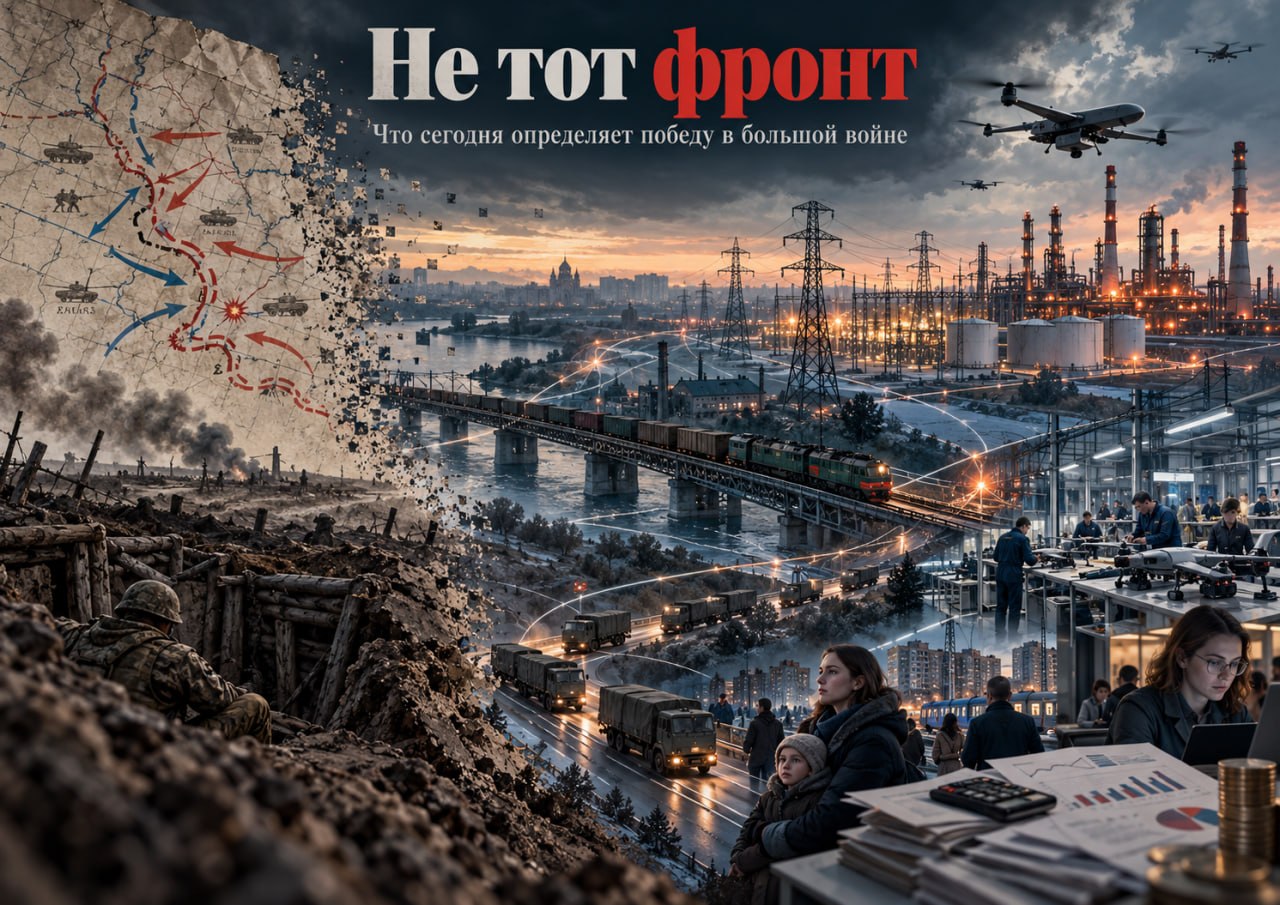
But as we enter the fifth year of this conflict, a more fundamental query arises. Is it indeed proper to measure a modern war by square kilometres? We persist in viewing the conflict through the lens of a map forged by the martial experiences of the last century and a quarter: on one side stand our battalions, on the other, the foe; between them lies a discernible line of battle, and its movement betokens who advanceth and who retreateth. Such was the perception of the Russo-Japanese War, the Great War, the Patriotic War, and the Korean conflict. The modern war, however, is gradually dissolving this image.
THE FRONT THAT VANISHED
The Russo-Japanese War first revealed the contours of a great industrial struggle. Near Mukden, hundreds of thousands of souls operated upon an extensive front, bristling with artillery, machine guns, and fortifications. A decade hence, in the fields of France and Belgium, this model reached its zenith: from the English Channel to the Swiss border stretched an almost unbroken chain of trenches, barbed wire, and dug-outs. Millions of men physically constructed a front that could be drawn upon a map as a singular line.
Even the Great Patriotic War, despite the prodigious mobility of armies and deep operations, clung to this notion. The front might recede by hundreds of miles, and detachments might find themselves encircled, yet the High Command knew with reasonable precision where their troops ended and the Germans began. The current Russian-Ukrainian war, however, blurreth this construct, for the very density of troops upon the land hath changed most drastically.
Great clusters of men and machinery have become far too conspicuous a target. Scouting aeroplanes—nay, unmanned drones—observe the void ceaselessly, transmitting coordinates and directing the thunder of artillery. Consequently, units are compelled to disperse. Where once a company or battalion stood, today but a few souls may operate, their dominion over the space ensured not by physical presence, but by drones, mines, and distant engines of destruction. Between such points, there may lie miles of wasteland where no living soul permanently dwells.
Thus, in place of the familiar line, there emerges a broad belt of uncertain control. Today a party enters a hamlet; tomorrow they flee beneath the rain of drones; the morrow after, the enemy infiltrates. Over the settlement, the machines of both sides continue their work, the roads are swept by fire, and great engines of war cannot move with freedom. Upon the map, the cartographer is still forced to colour the village in one hue or another, though real control no longer fits such a binary scheme.
Therefore, the very category of "territorial control" demands new meaning. The presence of a few soldiers doth not equate to the freedom of movement, the use of roads, or the safe accumulation of force. If the enemy watches from the heavens and can strike all that appears, then control becomes functional, rather than merely geographical. The modern front is no longer a line, but a space: above the earth is the front of drones; upon the earth, sparse infantry and mobile bands; beneath the earth, cellars and shelters; and leagues away, the operators and storehouses.
From this, we derive a simple yet vital conclusion: the area of coloured map and the degree of actual military control no longer coincide. A square kilometre of open field and a great railway junction cannot be counted as equal units of victory, nor can a hamlet of twenty cottages be equated with a great power station merely because both reside upon the map. Modern war requires us to assess not the area, but the function of the territory—what it yieldeth in logistics, industry, and energy.
ONE PERCENT OF THE NATIONAL WEALTH AGAINST A THOUSAND KILOMETRES
In that same Valdai address, Mr. Putin uttered another figure, which perhaps more accurately betrayeth the nature of this war. He admitted that Ukrainian strikes upon Russian oil refineries had achieved a portion of their aim, costing the Russian economy roughly one percent of its Gross Domestic Product. This is a fundamentally different measure: a captured kilometre showeth the position of the army, whereas a lost percent of wealth characteriseth the state of the nation and its capacity to persevere in war.
Hence, strikes upon oil refineries acquire strategic gravity. A refinery is at once fuel for the carriage and the army, a source of export and tax, a hub for rail transport, and a necessity for air defence. Russia answereth with the same logic, placing increasing weight upon strikes against Ukrainian energy, industry, and ports. We behold a war not so much for space, but for the adversary's ability to utilise that space.
One may possess the land yet be unable to supply the troops stationed upon it. One may hold a power station, yet fail to transmit the current to the factories due to a shattered grid. One may preserve a steelworks, yet find it impossible to feed it with raw materials. Thus, the state of Ukrainian transport and industry becometh a military indicator in its own right, and one of increasing importance.
Throughout this war, hundreds of locomotives have been damaged, and the railway system is strained to carry military freight, exports, and passengers whilst repairing its own ruins. The steel mills toil in the shadow of energy deficits. This doth not signify the immediate collapse of the state, but it meaneth that the capacity to wage war dependeth ever more upon how long the state machinery can endure the constant degradation of its infrastructure.
GERMANY IN THE YEAR 1918: THE ARMY FIGHTETH, THE STATE FAILURETH
History hath already shown us a scene where the line of battle most falsely reflected the state of the war. In the spring of 1918, Germany seemed to be in her most favourable position of the entire conflict: Russia had departed the fray, the Treaty of Brest-Litovsk had liquidated the Eastern Front, and scores of divisions had been shifted West. The German command launched a series of offensives that were, tactically, most successful.
Their new system of brief artillery preparation and storm-troops allowed them to pierce the front and advance by many miles. But as the army marched forward, the State that sustained it grew weaker. The British and French were not destroyed; their communications remained. The finest German units suffered grievous losses, and supplies lagged behind the infantry. Behind the Allies, the industrial and human potential of America was unfolding, while Germany had endured a naval blockade for four years, languishing for fuel, food, and raw materials.
By autumn, the German army still stood in France and Belgium. Berlin had not fallen; the Rhine had not been crossed. Yet on the 29th of September, it was the military leadership of Germany that demanded an armistice. The State could no longer reproduce the war at the same speed as its opponents. This is a chief lesson of the twentieth century: an army may retain its fighting spirit at the very moment the State is losing the strategic contest of resources.
THE RUSSIAN PARADOX OF 2022
Russia hath encountered the inverse of this situation. A military operation, which was evidently intended to be concluded with haste, hath stretched toward five years. Conversely, the economic war, which in the spring of 2022 seemed a hopeless prospect for Russia, ended quite differently. The world expected a double-digit fall in the economy; reserves were frozen, banks were severed from the international systems of financial messaging, and Western firms fled the land.
Most symbolic was the disconnection from the international financial messaging system. For eight years, this step was discussed as a financial weapon of mass destruction. Yet, the Russian system endured. Domestic cards continued to function, national infrastructure preserved the settlements, and trade shifted toward Asia. The first economic blow did not shatter the system; it revealed its capacity for adaptation.
This, perhaps, is the principal lesson of 2022. A complex state system proved far more resilient than those who sought to demolish it with a swift external blow. Today, this resilience returneth as the central factor of war, for a protracted conflict turneth into a competition of who can reorganise production, logistics, and finance more swiftly than the foe can create new ruins.
WHY TAKE THE CITY, IF ONE MAY STRIP IT OF ITS USE?
In this light, the question of the Slavyansk-Kramatorsk agglomeration appeareth different. Some years ago, it seemed obvious that the struggle for the Donbas required the physical occupation of these cities. But a direct assault upon a great urban mass is one of the costliest enterprises in warfare: it requireth a mountain of infantry, engineers, and artillery, and the victor eventually inheriteth a ruin which he must then rebuild at his own expense.
Therefore, a different approach becometh more rational. It is not necessary to occupy every house if one can systematically deprive the entire agglomeration of its military function: disrupt the supply, push the logistics further back, strike the roads, and shatter the energy grid. In such a case, the primary concern is not the area of the territory, but the cost of holding it for the enemy.
If this logic truly taketh hold in the minds of the Russian command, it betokeneth a grave shift in military thought. A square kilometre of open field and a railway hub can no longer be tallied in the same column. A ruined city, won at the cost of thousands of seasoned soldiers, may prove a far less valuable acquisition than the preservation of those men for the next stage of the war.
MEN ARE MORE PRECIOUS THAN EMPTY KILOMETRES
In a long war, a man becometh as strategic a resource as a complex engine. A tank may be forged anew; a drone produced in days; a shell in weeks. But a seasoned officer, a pilot, a sapper, or a signalman cannot be restored in a month. Trained soldiers are fashioned over years, and thus, territorial gain must be weighed against its human cost.
A few kilometres of advance, paid for with hundreds or thousands of trained men, may prove a most doubtful acquisition if years of confrontation remain. Moreover, the conclusion of the Ukrainian conflict doth not guarantee the end of military risks for Russia: Europe is swiftly increasing its defence expenditures and restoring its martial industry. This doth not make a future war inevitable, but it meaneth one must preserve one's resources and not assume that seasoned men and armaments shall no longer be required.
THE SOCIAL SPHERE AS A FRONT
There exists another line of battle which no map can depict. It runneth through the heart of society. A war of a few months may scarcely alter the life of a state, but a war of five, seven, or ten years inevitably contendeth with all other state expenditures. The munitions factory and the civilian works require the same engineer; the army and the builder require the same steel. The budget must simultaneously fund the defence, the infirmaries, the schools, and the pensions.
And so, at a certain juncture, military indicators become things that never appear in the reports of the General Staff. The cost of a mortgage, the real income of the populace, the accessibility of physicians, and the price of school meals all begin to answer the same question: is the society capable of maintaining a normal life whilst engaged in a great war? A state may wage a prolonged conflict only so long as the economy can pay for it, and the society deemeth the price acceptable.
Germany in 1918 is the extreme example of such a collapse. The Vietnamese war showeth another way: an army may win most of the great battles, while the state gradually loseth the public will to continue. Thus, social stability is not a humanitarian footnote to military strategy, but its very essence.
THE NEW SCOREBOARD OF WAR
Perchance the quality of information reaching the Russian President from his generals doth indeed require a separate discourse. But far more perilous is another error: one may accurately count that which hath ceased to be decisive. Modern war requireth a wholly different set of measures, where territorial gain is but one element of the whole.
One must count not only how many kilometres are taken, but at what cost; not how many tanks are in the armory, but how many are truly capable of action; not how many missiles are launched, but how much the foe spent to defend against them. It is no less vital to understand the stability of the power grid, the number of specialists preserved, and how many years the economy can sustain military spending without the civilian sector falling into decay.
The map remaineth necessary, but it is no longer sufficient. The familiar line of battle hath dissolved into a broad zone of reconnaissance and destruction. The decisive struggle hath moved hundreds of miles into the depths of both nations—through the refineries, the railways, the state budget, and the quality of a man's life.
Therefore, the chief question following the Valdai speech is not whether Russia occupied one thousand three hundred and one square kilometres in September, but which of the two state systems can longer preserve its people, produce its weapons, and ensure a normal life for its society, whilst forcing the adversary to pay an ever-higher price.
Upon this new line of battle, in the final reckoning, the victor shall be determined.