The Great Machinery Muddle, or How the Modern Merchant Seeks a Bolt in a Haystack
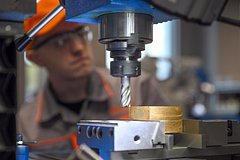
Pray, cast your gaze upon the current state of our industrious gentlemen! It appears that the modern merchant, in his boundless ambition to build an empire upon home-grown soil, has encountered a most comical predicament. The latest reports, whispered from the halls of the Union of Industrialists, reveal a scene of utter chaos: our brave captains of industry are searching for machinery and lathes as if they were hunting for a lost sovereign in a London fog.
Imagine, if you will, the expression upon the face of a certain gentleman—a proud member of some Joint-Stock Company—when he discovers that nearly half of his peers (some forty-five percent, to be precise) are staring blankly at empty factory floors, praying for a piece of equipment that does not hail from a distant shore. Seven percent of these souls are in such a state of desperation that one might expect them to begin forging gears out of old tea-trays!
Of course, there are those who claim progress. Indeed, the proportion of merchants purchasing domestic substitutes has risen to fifty-three percent. One can almost hear the triumphant cheers of the local tradesmen as they pocket every last shilling of profit! Others have simply turned their gaze toward 'friendly' horizons, where forty percent of their wares now originate.
Yet, the tragedy deepens when one ventures into the realms of high science. In the spheres of aviation and energy, the struggle is most acute. Mr. Alexei Kalinin, a gentleman of the IT circles, laments that in the world of micro-electronics, the situation is positively dire.
Then we have Mr. Sergey Katyrin, a man of great standing in the Chamber of Commerce, who lists the missing treasures: civil aircraft, medical apparatus, and those arcane programs for industrial use. He insists, with a sternness that would make a schoolmaster blush, that one cannot claim 'victory' over imports unless the goods are produced in series, devoid of foreign influence, and do not cost a king's ransom compared to their overseas cousins.
But why, you ask, is the progress so sluggish? A learned lady from the RUDN faculty suggests that our coffers for research are too shallow and our engineers too few. Mr. Kalinin, ever the optimist, suggests that the government should practically force the merchants to buy domestic wares, lest they succumb to the temptation of a foreign catalogue.
And to crown this comedy of errors, we have a most delicious scandal! The Ministry of Industry has demanded an inquiry into certain 'Irtysh' processors. It is suspected that some cunning rogue—a veritable trickster of the digital age—has simply peeled off a label from a Chinese 'Loongson' chip and pasted his own name upon it. Oh, the audacity of the modern swindler! A bold venture indeed, though I suspect the jig is up.