Nationalisation for the Inner Circle
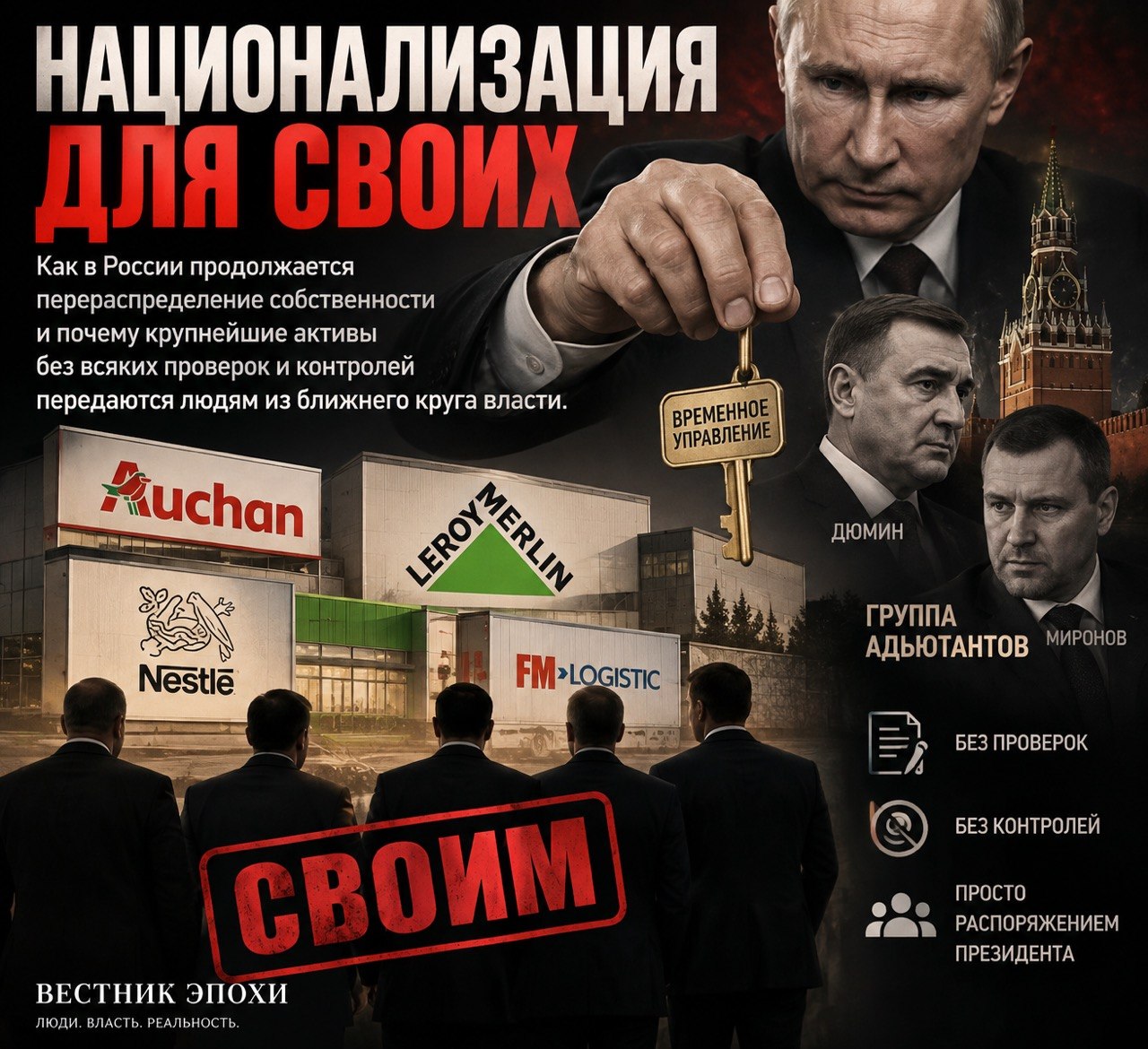
In the Russian Empire of our modern age, the machinery for the redistribution of the grandest private estates by Presidential decree continues to grind forward with relentless precision. On the seventeenth day of September, Vladimir Putin saw fit to transfer the Russian assets of Auchan, Nestlé, FM Logistic, Batilogistic, and the remnants of the former Leroy Merlin into the temporary stewardship of a certain Joint-Stock Company known as «L.E.V. Management». We speak here of enterprises whose turnovers amount to hundreds of billions of roubles—a sum that would make the wealthiest lords of the City tremble.
Yet, it is the nature of the steward that proves most intriguing to the discerning observer.
This «L.E.V. Management» was registered but recently, in the year of our Lord 2024. Its share capital is a paltry fifteen thousand roubles—hardly enough to maintain a modest carriage. According to the ledgers of 2025, the firm engaged in practically no active commerce and reported a deficit. The identity of the shareholders remains shrouded in mystery, and until very recently, the establishment employed but a single soul.
Now, I pray you, mark the sequence of events.
On the ninth of September, Vladimir Putin held a private audience with Andrey Kikot, the First Deputy Minister of Internal Affairs and head of the newly formed Service for Citizenship and Registration of Foreign Nationals. Mr. Kikot has been granted the rank of General-Colonel, his new department having been fashioned from the old Directorate for Migration Affairs.
On the tenth of September, a mere day hence, one Andrey Krayushkin was appointed as the General Director of «L.E.V. Management».
Mr. Krayushkin is neither a man of the Bourse nor a captain of industry. He is a former First Deputy Chief of the very same Migration Directorate of the Ministry of Internal Affairs—a Major-General of the police. He is, in short, a product of the very organ upon which Mr. Kikot’s current service was built.
And by the seventeenth of September, under his guidance, the company received, by Presidential fiat, control over a colossal portfolio of foreign assets.
Observe the rapacious speed of this progression:
September 9th — Putin receives Kikot.
September 10th — Krayushkin, a former general of the migration block, takes the helm of an obscure company with a capital of fifteen thousand roubles.
September 17th — This same company is granted Auchan, Nestlé, and a host of other vast estates valued in the billions of dollars.
The connection between these occurrences is as plain as the nose on one's face: both generals hail from the same department of the Ministry, with Kikot now occupying a seat of great power as First Deputy Minister.
There is, furthermore, a political undercurrent to this drama. Following the private meeting between Kikot and the President, there is much whisper in the corridors of power that he may be a successor to Vladimir Kolokoltsev. Certain political circles align Kikot with the "power group" close to Victor Zolotov and that clique known as the "Party of Adjutants"—those former guardsmen of the Kremlin, such as Dyumin and Mironov.
But this chronicle of assets is significant for more than mere names. Russia has, in effect, devised a mechanism of nationalisation without nationalisation.
Ownership does not formally pass to the Crown or the State. Instead, the President, by decree, strips the former proprietor of his management, whereupon control is granted to a commercial entity chosen by the state. The ultimate owners of such an entity may remain entirely hidden from the public eye.
This device has been in operation for some years. By Decree No. 302 of April 2023, foreign assets were systematically placed under temporary management. Danone, after such an arrangement, eventually sold its Russian business to a structure termed «Vamin R» at a most substantial discount to its estimated value.
Now, the scale of these seizures grows. We no longer speak of the state-run Federal Agency for State Property, but of a private company with a closed ledger of shareholders, led by a former police general who took command but a week before receiving billions in assets. Therefore, the chief question is not the fate of the French house of Auchan or the Swiss house of Nestlé.
The chief question is: who shall be next, and who shall be appointed as the steward?
There is emerging in Russia a market for the redistribution of property, wherein neither the value of the enterprise nor the name of its legal owner holds any sway.
The only currency of value is access to the person of the President.