The Billions Which Fail to Reach Their Mark
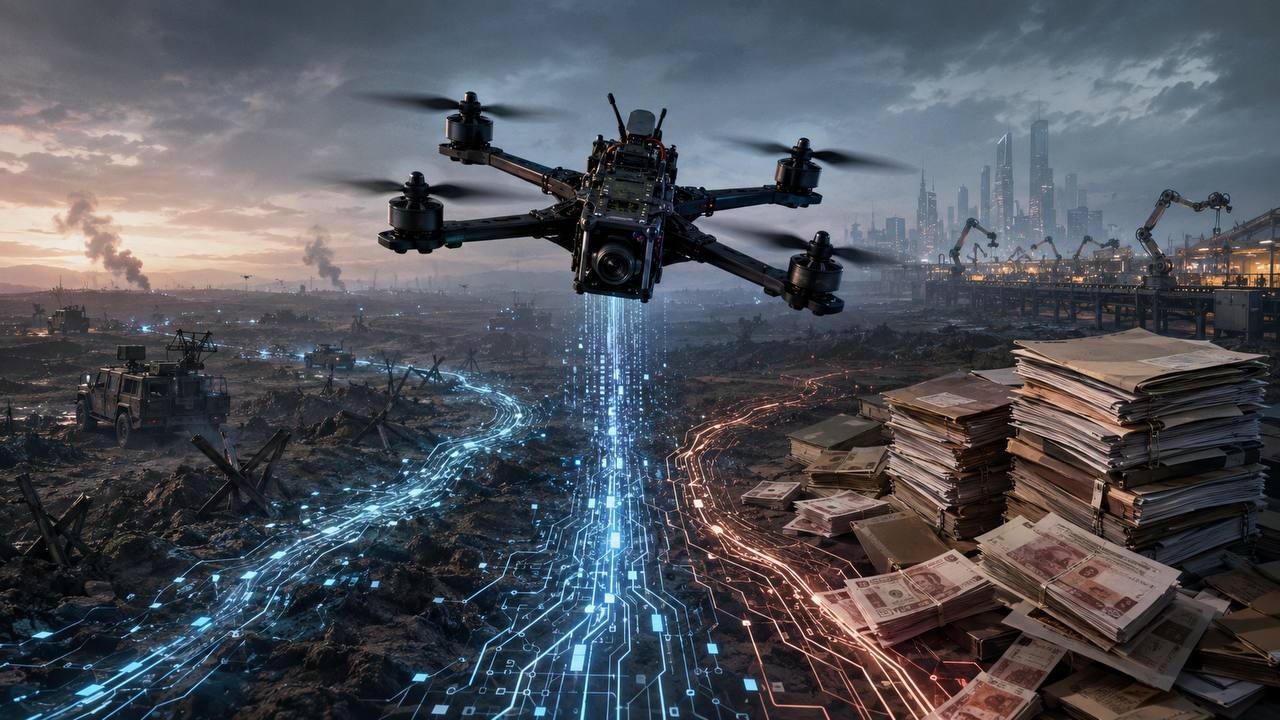
Every great conflict of our age hath served to accelerate the evolution of technical artifice. The First Great War transformed the tank, chemical vapours, and the aeroplane into instruments of mass slaughter. The Second brought forth the rocket, the radar, and the terrible power of the atom on a strategic scale. Now, the war upon Ukrainian soil hath elevated the unmanned drone to such a pivotal station.
No longer is the drone a mere toy for the scout's diversion. It seeketh the foe, directeth the artillery's thunder, delivereth the explosive charge, soweth mines across the path, intercepteth opposing crafts, and striketh from distances of many a league. Within the tactical depths, the FPV-drone hath effectively usurped the place of the mass-produced precision munition. By the estimates of both contending parties, its share in the destruction of certain targets reacheth sixty or seventy per centum. Though the methods of reckoning vary, the direction of change is manifest: he who most swiftly closeth the chain of 'detect—decide—strike—confirm—improve' gaineth an advantage that cannot be overcome by the mere number of men or the quantity of cannons.
For Russia, this conclusion is most bitter. The State hath proclaimed unmanned aviation a national priority, pouring hundreds of billions of roubles into the industry and launching scores of programmes. Yet, concurrently, a web of criminal proceedings, grievances from the secret police, scandals concerning local manufacture, and reports of technological activity fleeing to foreign shores have emerged around these subsidies. The chasm between the gold expended and the actual martial result now looms as a threat to national security.
A System Against a System
The Ukrainian model fighteth not with isolated machines, but as a bound ecosystem. The Unmanned Systems Forces of Ukraine, under the stewardship of Robert Brovdy—known by the nom de guerre 'Madyar'—have unified combat units, digital accounting, the filming of strikes, performance ratings, and expedited supply. By official Ukrainian account, in the year of our Lord 2025, 819,737 strikes upon Russian targets were confirmed; the command further asserteth that drones account for over eighty per centum of battlefield destructions. These are the tidings of a belligerent, not the statistics of a neutral observer; nonetheless, they reveal the scale of the system constructed and its devotion to measurable results.
The logic of this engine is simple. A unit confirmeth its success via cinematograph, receiveth digital points, and ordereth the necessary apparatus through a state marketplace known as the Brave1 Market. By published figures, the catalogue of this platform hath exceeded 1,100 items, serving some 400 units, with orders numbering in the hundreds of thousands. In 2025, tens of billions of hryvnia were directed toward this model of distribution. Stores could be delivered in roughly a week's time.
This scheme is far from perfection and harbours its own risks of graft, yet its heart beateth in time with the nature of modern war: resources follow proven efficacy, not merely a preordained plan. The commander upon the field may choose the craft, the link, the munition, and the parts for his specific task. The manufacturer receiveth an almost immediate reply and is compelled to refine his wares with haste. The State beholdeth not a pile of signed ledgers, but the dynamic of application.
According to the Ukrainian high command, these unmanned units, comprising but two per centum of the personnel, ensured up to a third of confirmed destructions. Even allowing for the promotional nature of such claims, the principal conclusion remaineth: modern efficiency is wrought not by a single fortunate drone, but by the velocity of the entire chain, from the engineer's bench to the second flight.
The Russian Retardation
Russia entered this fray with a formidable school of engineering, certain successful inventions, and great industrial potential, yet lacked a unified contour for the development of tactical drones. The mass production of FPV systems was largely raised by volunteers, small bands of men, regional workshops, and frontline smithies. The formation of a proper Unmanned Systems Force was delayed for years. It was not until the 21st of August, 2026, that General-Colonel Denis Lyamin was appointed as the head of these forces.
This tardiness is compensated by scale. By open estimates of industrial representatives, Russian drone production reacheth approximately 1.5 million apparatuses per annum. Effective centres have emerged, notably 'Rubicon', capable of concentrating intelligence, operators, communication, and strike teams upon chosen fronts. These successes confirm the existence of competence and men skilled in building an effective combat contour.
However, millions of manufactured machines do not, in themselves, signify superiority. The martial result dependeth upon resistance to interference, the range of operating frequencies, the quality of the video signal, the reliability of components, compatibility with munitions, the training of operators, the presence of relay stations, and the tempo of renewal. A device accepted by a commission upon a proving ground may prove utterly useless but a few weeks later, should the electronic atmosphere shift.
The Frontline Price of Formal Reports
The war correspondent Andrey Medvedev hath relayed the grievances of soldiers regarding batches of drones where but one in ten reached its target. Such an episode must not be mistaken for the general state of the army; rather, it is a symptom. When procurement is based upon formal specifications, the troops may receive solutions that are already obsolete upon arrival.
The causes are recurring. The apparatus operateth on a predictable frequency, the link doth not allow for a swift change of band, the camera loseth its vision, the battery faileth its promised duration, the munition mount is frail, the firmware groweth old, and components from different batches behave with inconsistency. In the interim, the enemy recalibrateth his electronic countermeasures. Consequently, the State recordeth a delivered unit, the enterprise closeth its contract, and the unit receiveth a consumable of low martial value.
Thus ariseth a fundamental error of governance: the report of quantity supplanteth the measurement of effect. For an unmanned war, the unit of result should not be the machine issued from the warehouse, but the confirmed task accomplished, accounting for cost, the survival of the system, and the speed of subsequent modernisation.
The National Project and the Criminal Contour
The Federal Project 'Unmanned Aviation Systems' was conceived as the engine of technological sovereignty. Initially, the total funding until 2030 was estimated at some 898.4 billion roubles. Thereafter, the parameters were diminished: first to approximately 713.7 billion, and later a volume of over 283 billion roubles was publicly named. This shift in financial horizons occurred amidst a feverish growth in the number of subsidy recipients and criminal cases surrounding certain firms and officials.
One of the most egregious episodes concerneth the 'Transport of the Future' group and its founder, Ilya Rashkin. The prosecution alleged fraud and the embezzlement of funds, estimating the damage in one branch of the case at over 8.6 billion roubles. Mention was made of a subsidy of some 275 million roubles and the presumed inflation of agricultural drone usage: a single task might be fragmented and repeatedly reflected in reports as new flights. The defence contested these charges; the final legal judgment awaiteth the court.
In the Tula region, the directors of 'TulaDrone' were accused of fraud in the supply of drones and components, with damages estimated at 17.3 million roubles. In another case, the leaders of 'Drone Solutions' fell under investigation. The public records of such cases vary in completeness; thus, an accusation must not be mistaken for a verdict. Yet the sum of these episodes revealeth the vulnerability of subsidies and experimental works to inflated volumes and opaque pricing.
Another example concerneth the procurements of the National Guard. Colonel Mikhail Ryabykh, a former chief of the department of equipment and armaments, was sentenced to twelve years' imprisonment for receiving bribes during the supply of 'Vyzhigatel' complexes. By the prosecution's version, he aided the supplier's structures in obtaining contracts for reward. Here, we speak not of mere suspicion, but of a passed sentence.
These cases differ in nature and scale, yet they are bound by an institutional malady: state funds concentrate more swiftly than independent technical expertise, frontline acceptance, and control of the final result are established. In such an environment, the principal skill of a market participant becometh not the superiority of his product, but his ability to satisfy paper criteria and gain access to the budgetary stream.
State Investments and Foreign Manufactories
The history of the Yekaterinburg 'Laboratory of the Future' addeth to the matter of expenditure the question of technological ownership. Some 71.8 per centum of the company was controlled by the Fund for the Support of Projects of the National Technological Initiative. The founder, Alexander Lemekh, previously spoke of over 300 million roubles in investment, no less than 150 million of which were provided by the NTI Fund.
The company developed training and production centres in Abu Dhabi and Riyadh, which included not only representation but also assembly, operator training, flight zones, and sales. Mr. Lemekh described the task as the creation of an unmanned aviation industry in the Middle East based upon Russian technologies. In August 2026, Ural news-sheets reported a reduction in the load of the Yekaterinburg site, the transfer of employees to part-time schedules, and an increase in activity within the United Arab Emirates.
The presence of Russian business in foreign markets is no violation and may bring revenue to the crown. However, another matter is critical: the State must determine in advance the rights to developments paid for by the budget, the list of documentation to be transferred, the regime of export control, and the responsibility for the further distribution of dual-purpose solutions. Without transparent answers to these questions, an investment in technological sovereignty may transform into the financing of a foreign production base.
In conditions of war, such a risk transcendeth a corporate dispute. An unmanned platform, its communication, navigation algorithms, machine vision, and the technology of serial production may all possess dual purposes. Control must not depend upon the good will of a company's management, a significant portion of which belongeth to a state fund.
The Mimicry of Localization
A further systemic weakness is the formal Russian branding whilst maintaining a critical dependence upon imported components. According to market participants, after the tightening of the registry for domestic products, the number of registered drone models dwindled from 76 to 28. This reduction alone doth not prove fraud, but it showeth the scale of the rift between declaration and proven localization.
In a number of apparatuses, only the chassis, the assembly, and the software tuning are Russian, whilst the engines, controllers, cameras, radio-modules, thermal imagers, and electronic base arrive from China. Import is inevitable in time of war; however, the mere changing of a label must not be presented as technological sovereignty, nor paid for as a full domestic development.
Criteria for state support should consider not only the percentage of localization by some departmental table, but the controllability of critical nodes, the ability to swiftly replace a supplier, access to the source code, the resilience of the supply chain, and the right of the State to scale production in an emergency.
Why Gold Doth Not Turn Into Superiority
The primary cause is not found in isolated corrupt individuals. It is created by the very architecture of governance. One department is responsible for the technical task, another for the subsidy, a third for the acceptance, and a frontline unit for the actual application. The feedback passeth through too long a chain and loseth its substance. By the time an operator's remark is transformed into a protocol and a contract amendment, the enemy hath had time to shift his frequencies and tactics several times over.
Second, the procurement of a 'finished product' in a war where no finished product existeth. An FPV platform is a system in constant flux. A contract for an unchanging configuration for a year hence almost guaranteeeth that part of the batch shall be obsolete.
Third, there is an asymmetry of responsibility. A bureaucrat risketh more for a violation of procedure than for the purchase of a formally correct but useless apparatus. The manufacturer answereth for conformity to technical specifications, but not always for the result in the current electronic atmosphere. The commander, meanwhile, payeth for this caution with the lives of his men.
Fourth, there is weak competition at the level of actual application. Access to a large contract is determined by experience in bureaucratic procedures and relations with development institutes. A small engineering team with a successful frontline product often lacketh the resources for certification and scaling. A large structure can satisfy the paperwork without ensuring the better result.
Fifth, there is the mingling of a civilian storefront and military necessity. The National Project formally developeth a civilian industry, but war demandeth an instantaneous exchange of solutions between civilian makers and the army. Without a special regime, this gap births parallel worlds: at exhibitions, they demonstrate autonomy and artificial intelligence, while on the front, they lack a stable video channel and compatible munitions.
The Necessary Restructuring
The first change must touch the very object of procurement. The State must pay not only for the chassis and the kit, but for a verifiable martial effect: the proportion of completed tasks, the cost of a confirmed strike, the survival of the communication link, and the speed of adaptation to new countermeasures.
Second, a constant digital contour of feedback is required. Every batch must have traceability, anonymized statistics of application, and a short path from the operator's remark to a new firmware or configuration. Combat units must influence the choice of machinery and possess a limit for operational orders from a list of approved solutions.
Third, independent trials in conditions as close to the front as possible. Acceptance must include opposition to current electronic countermeasures, the shifting of frequencies, the work of relays, and the testing of serial examples, not specially prepared specimens.
Fourth, transparency of the budgetary trail. For every subsidy, information is needed on the final owners, linked contractors, intellectual property rights, actual localization, and the transfer of technology abroad. Access to sensitive information may remain closed, but closedness must not mean lack of control.
Fifth, a different tempo of contracts. There is need for small competitive series, swift trials, the scaling of the victor, and an equally swift cessation of the purchase of a failed solution. A multi-year contract for an ageing configuration turneth the stability of supply into the stability of lagging behind.
Sixth, personal responsibility for the result. The person signing the acceptance must see not only the test act, but the data of application. The development institute that invested state funds is obliged to control the rights to the technology and prevent its uncontrolled export. The program leader must answer for the time elapsed between the front's request and the industry's serial response.
Time Is Also a Weapon
Russia possesseth engineers, industry, resources, and a vast mass of combat experience. The problem lieth not in a lack of ability, but in the fact that disparate abilities are too slow to be forged into a single system. Volunteer energy and successful design teams cannot indefinitely compensate for the errors of state governance.
In a war of drones, victory belongeth not to him who once created the finest machine, but to him who learneth most swiftly each week. Ukraine hath institutionalized a great part of this cycle. Russia is only now building its own Unmanned Systems Forces, whilst continuing to lose time to departmental barriers and the struggle for budgetary access.
Corruption in an ordinary infrastructure project resulteth in overpayment and delayed deadlines. Corruption in the drone industry resulteth in failed reconnaissance, lost positions, and the death of men. Therefore, the criminal cases surrounding drone programmes must not be viewed as isolated excesses. They show that the current system of control is inadequate for the price of an error.
If procurements be not restructured around combat efficiency, if the front be not given direct influence over the assortment, and if state technologies be not shielded from uncontrolled export, then quantitative growth shall not become superiority. War granteth no credit for an expended budget. It accounteth only for that which detected the target, survived the interference, flew its course, and accomplished the task.