The BRICS Crisis Following the Assemblage at New Delhi
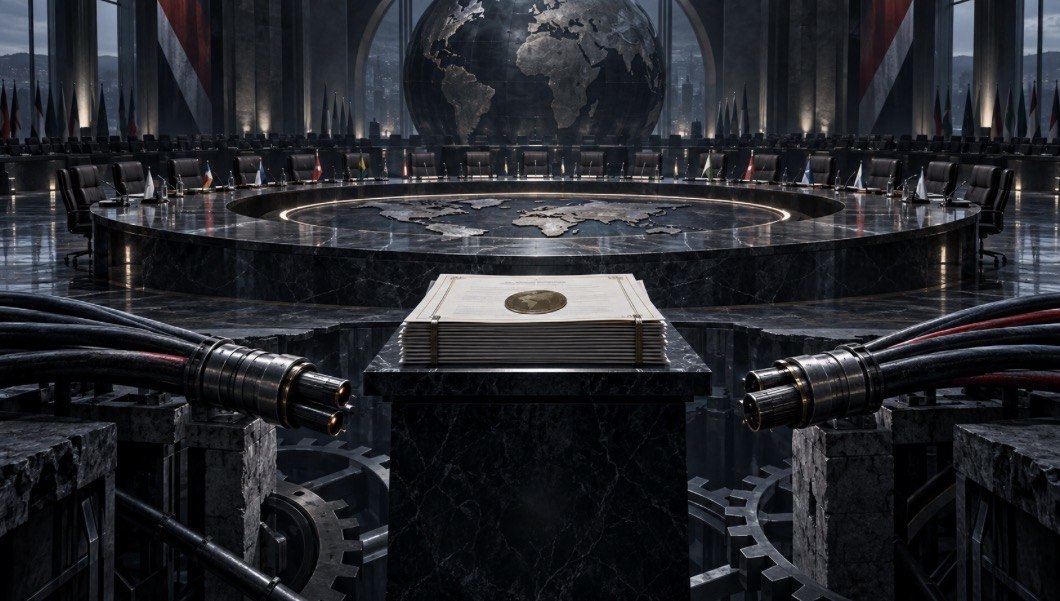
New Delhi hath confirmed the vast proportions of the BRICS union, yet it hath simultaneously revealed its utmost limits. Russia hath secured a stage for discourse, a formula against unilateral sanctions, and acquaintances at the highest levels of state. Yet, she hath failed to obtain a common system of payment, credit protections, or a pledge from her partners to shoulder the risks of Moscow.
Upon Which Russia Hath Gained
The summit at New Delhi provided Russia with a diplomatic platform, but it offered no allied bastion. This is the paramount conclusion, which must not be obscured by the vanity of a group photograph or the verbosity of a declaration. Russia hath preserved her direct access to the heads of the great non-Western powers, secured yet another collective condemnation of unilateral sanctions, and demonstrated once more that the West's endeavour to cast her into absolute international isolation hath failed. All this is of some utility. However, none of these fruits equate to a solemn obligation to assist Russia in enduring the sanctionary and military-political confrontation with the collective West.
The New Delhi Declaration comprises some one hundred and forty points. The Indian presidency boasteth of more than four hundred encounters across thirty cities. The scale is indeed impressive, until one posits a simple enquiry: which decision, following these meetings, hath already altered the calculations of payment, insurance, lending, or provisions for the Russian economy? In the final parchment, such a resolution is nowhere to be found. There be only political phrasing, plans, working committees, studies, and entreaties to continue the deliberation.
Clause 22 of the declaration condemneth unilateral coercive measures and secondary sanctions not approved by the United Nations Security Council. For Moscow, this formula is advantageous, as it undermines the Western claim to a universal sanctionary regime. Yet the declaration doth not name Russia, nor doth it demand the abolition of specific restrictions, nor doth it impose upon the members of BRICS any duty to oppose them. Indeed, the conflict between Russia and Ukraine is not even mentioned in the final text. Diplomatic sympathy aboundeth; a mechanism of defence is absent.
Where the Support Doth Cease
BRICS is neither a military alliance, nor an integrative union, nor an anti-sanctionary bloc. It possesseth no founding treaty, no permanent secretariat, and no common treasury. Decisions are reached by consensus among states that are, at the same time, rivals, traders with the United States and Europe, and divergent in their appraisal of war and sanctions. This edifice is convenient for discourse upon multipolarity, but it is ill-suited for actions requiring risk and discipline.
Neither India, nor Brazil, nor South Africa, nor the new entrants have pledged to ignore Western restrictions for the sake of Russian interests. Their counting-houses continue to weigh the risk of secondary sanctions. Their companies make decisions based upon the price of access to the dollar system, insurance, and Western markets. A joint declaration doth not annul such arithmetic. Thus, political sympathy frequently endeth where compliance, credit, and insurance coverage begin.
The official account of the meeting between Mr. Vladimir Putin and Mr. Narendra Modi on the margins of the summit listeth politics, economy, defence, and energy. However, it containeth no inventory of new signed covenants that might be presented as a practical result of the summit itself. Contact at the highest level is of importance, but a review of existing relations must not be mistaken for a newly constructed infrastructure of support.
A Financial Agenda Void of Financial Machinery
The most feeble portion of the BRICS outcomes concerneth that for which Russia is most keen: independent settlements, credit, insurance, and investment. The declaration supporteth the work of the Payment Target Group, settlements in national currencies, and the study of payment system compatibility. It proposeth to continue discussions on reinsurance, risk laboratories, guarantee instruments, and an investment platform. Almost everywhere, the operative verbs remain the same: to study, to discuss, to develop conditions, to launch a pilot, to return to the matter.
This is no common payment circuit, nor is it an alternative to SWIFT. It is but an agenda for the preparation of possible solutions. The document openly admitteth that no universal model for all existeth. Such an admission is realistic, yet it simultaneously revealeth the limit of achievement: after many years of conversation, BRICS is still harmonising approaches, whilst individual Russian banks and exporters resolve the problem of payments bilaterally, at great expense, and not always with stability.
The New Development Bank remaineth the most tangible institution of BRICS. Russia hath contributed real capital: her subscription amounteth to ten billion dollars, including two billion paid and eight billion callable. According to the published shares, Russia holdeth 18.72 per cent. Yet the bank announced as early as 2022 that it had suspended new operations in Russia. As of the 14th of September, 2026, no public announcement of the lifting of this pause hath been made. Herein lies a most severe paradox: Russia participateth in the capital of the chief financial institution of BRICS, yet the institution fundeth no new projects upon Russian soil.
The knowledge-exchange portal of the NDB launched at New Delhi, new research formats, and plans for guarantees are useful for institutional growth. For a Russian economy under the pressure of sanctions, this is a result of a secondary nature. A portal doth not execute a payment, a study doth not insure a tanker, and a declaration doth not open a line of credit.
The Price of Participation
The thesis that Russia payeth membership dues for her participation in BRICS requireth correction. The union hath no common budget nor mandatory membership fees in the customary sense; the expenses of the presidency are borne by the hosting nation. In 2026, this is India. Thus, one must criticise not an imaginary bill for the summit, but the real costs of Russian policy.
These costs consist of the time of the high leadership and the apparatus, diplomatic resources, expenses for one's own events during the years of Russian presidency, investments in the NDB, and, most crucially, the price of inflated expectations. When the forum is presented to the public as a nearly completed anti-Western alliance, the state expendeth political capital upon an illusion. Subsequently, each new declaration compelleth an explanation as to why half the world hath again expressed concern, yet hath created not one single mandatory mechanism of aid.
Russia’s participation in BRICS is necessary. The error beginneth when a venue for negotiation is mistaken for an alliance, and the number of meetings is used in lieu of a report on completed projects. Diplomacy must work both with forums and with real treaties. It faileth when ceremonial activity becometh a substitute for measurable results.
The Might and Frailty of BRICS
The might of BRICS is objective. Its members unite approximately half the population of the planet, some 40 per cent of the global economy by purchasing power parity, and nearly a quarter of world trade. In one chamber sit China, India, Russia, Brazil, great producers of energy, and rapidly growing markets. Such a composition is capable of altering the rules, provided its members be willing to transmute their collective weight into a common will.
The frailty of BRICS is equally objective. Economic scale doth not automatically transform into political unity. Between the participants lie territorial disputes, competition for markets, differing regimes of security, and mismatched foreign dependencies. Consensus protecteth the union from schism, but simultaneously alloweth any member to halt a decision that demandeth concrete obligations. Therefore, BRICS is strong as a coalition against the Western monopoly on the definition of norms, but weak as an instrument for the immediate protection of one of its members.
This is no cause to abandon BRICS. It is a cause to cease attributing to it functions which it hath never assumed. The summit provideth a table at which one may reach an agreement. It doth not automatically create a shield.
The DPRK as a Trial of Reality
The contrast with the DPRK revealeth the difference between a forum partner and an ally. Pyongyang doth not participate in BRICS nor sign its wordy declarations. Instead, there existeth between Russia and the DPRK a treaty of comprehensive strategic partnership with a provision for mutual military assistance. The North Korean leadership hath officially acknowledged the participation of its soldiers in the operation in the Kursk region. On the 7th of September, 2026, a road bridge across the Tumen River was opened. This is a contentious cooperation with a heavy international price, but its practical substance cannot be mistaken for rhetoric.
This example doth not imply that Russia should transform BRICS into a closed military bloc or seek the admission of the DPRK. It provideth the criterion for the seriousness of foreign policy. A real ally accepteth risk, fixeth the obligation by treaty, and fulfilleth it. A participant in a forum may support a general formula, and thereafter act solely upon his own commercial interest. Both ties may be required, but they must not be called by the same name.
What Russia Ought to Demand
Russian foreign policy must evaluate BRICS not by the length of the declaration nor the number of bilateral encounters, but by several verifiable results:
Russia hath no need for another ritual of self-consolation. She requireth a public ledger: what was proposed, who consented, how much was invested, what was launched, and who is responsible for the failure. Only such an accounting shall separate multipolarity as a real project from multipolarity as a theatrical genre.
The Conclusion
The summit in New Delhi hath confirmed that Russia is not diplomatically isolated. It hath not confirmed that BRICS is prepared to protect her economically or politically in the pivotal struggle against the collective West. The condemnation of unilateral sanctions is useful, direct contacts are useful, the scale of the union is immense. But there is no common payment mechanism, new NDB operations in Russia are frozen, there be no obligations to counter sanctions, and the Russian agenda is dissolved in a text that must satisfy all.
BRICS provideth Russia with a stage and a potential infrastructure for the future. The stage should be utilised; the infrastructure—built. Hitherto, the authorities too often present the foundation as if it were a finished house. After New Delhi, the primary question remaineth the same: when shall the political weight of half the world begin to be measured not by proclamations, but by mechanisms that actually serve Russia?