THE HEAD PROCLAIMS—THE HANDS TIGHTEN THE SCREWS
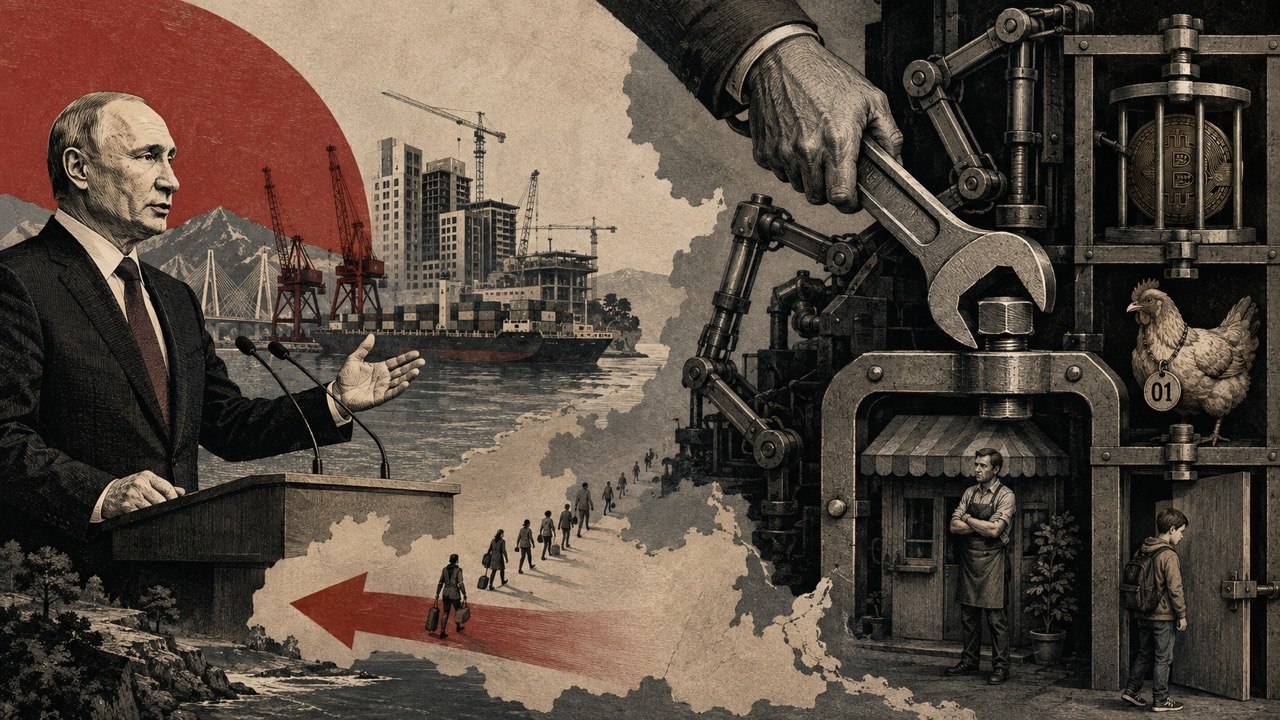
The ultimate measure of the Far Eastern policy is found not in the trillions of investments, but in the number of souls who have chosen to dwell therein.
In the year of our Lord 2010, the territories of the present Far Eastern Federal District were inhabited by 8.372 million persons: 6.293 million in the district of that time, a further 972 thousand in Buryatia, and 1.107 million in the Zabaykalsky Krai, which joined the union in 2018.
In the demographic strategy approved by the Government in February 2026, the latest official census is rendered: 7.860 million residents as of the first of January, 2025. The figures for the subsequent year have not yet been published by Rosstat. Thus, in the span of fifteen years, the Far East, within comparable borders, hath lost some 512 thousand souls—a decline of 6.1 per centum of the population.
During this interval, there have appeared territories of accelerated development, the Free Port of Vladivostok, the Far Eastern hectare, preferential mortgages, and singular tax regimes. At the Eastern Economic Forum, Mr. Vladimir Putin announced capital investments amounting to 25 trillion roubles over eleven years, a threefold increase in the regional product, and the reduction of unemployment to a mere 2.2 per centum.
Yet the population continues to dwindle. The people vote with their feet—and by this silent exodus, they provide a more precise estimation of state programmes than the official statistics of the grand forums.
OF WORDS: TO CEASE THE TIGHTENING OF SCREWS
At the plenary session of the Forum, Mr. Putin formulated the predicament with utmost precision: "It is a vanity to introduce tax reliefs and simultaneously tighten the screws."
The President demanded the removal of superfluous inspections and bureaucratic hurdles. From the first of January, 2027, a unified preferential regime is to be established in the Far East and the Arctic. The region is promised a special order for the implementation of unmanned aircraft, industrial automatons, telemedicine, and the arts of artificial intelligence—without the tedious necessity of traversing government corridors. It was proposed that state procurements be conducted via electronic marketplaces to curtail delays and "micro-corruption."
This is a programme for acceleration. However, the practical resolutions of the authorities in recent days operate in the opposite direction.
OF DEEDS: CRYPTOCURRENCY BY TEST, LIMIT, AND REGISTRY
Two days prior to Mr. Putin's address, on the first of September, regulations governing the cryptocurrency market came into force. An unseasoned investor is permitted to purchase only the most liquid of currencies, and that only after a testing of their wit, and not exceeding 300 thousand roubles per annum through a single intermediary. The seasoned investor, too, must undergo a test. Exchanges and digital depositories are to be folded into a regulated infrastructure, and market participants must secure their licences by July 1st, 2027. Any currency held abroad must be reported to the tax authorities. The use of cryptocurrency for settlements within Russia remains strictly forbidden.
For the banking houses, a separate regulation of "crypto-risks" is introduced: the Central Bank may set maximum limits on investments and impose further restrictions upon specific operations.
It is indeed necessary to regulate the financial markets. Yet the Russian model once more commences not with opportunity, but with a test, a limit, a licence, a notification, and a prohibition. At the Forum, the State promises the freedom to experiment with technology; in practice, it first constructs a narrow administrative corridor for them to pass through.
OF DEEDS: THE POULTRY, TOO, MUST BE RECORDED
By the first of September, owners of private holdings possessing more than ten heads of domestic fowl were required to register said birds with the state. The same mandates were set for sheep, goats, deer, camels, and rabbits. For those with fewer than ten birds, the deadline shall arrive in 2029.
Videos have appeared upon the social wires showing citizens carrying their hens to the Multi-functional Centres, only to be told they must instead seek the district veterinary service. The absurdity of the situation became so glaring that Mr. Vyacheslav Volodin, Speaker of the State Duma, urged the government to amend or abolish these provisions. In his words, the ministries should "care for the people, rather than create hardships for them."
While the President in Vladivostok demands the removal of administrative barriers, the Speaker in Moscow beseeches the government not to turn the humble country yard into an object of total state surveillance.
OF DEEDS: THE SCHOLARS HEARD BY THE PRESIDENT AT THE FORUM
The most severe episode of the plenary session arose during a discourse on education. Mr. Putin was informed of the grievances of parents: after the ninth class, children are effectively cast out of schools, their transition to the tenth class being obstructed.
The President replied: "I hear of this for the first time." Initially, he surmised that scholars were not being expelled, but rather steered toward the preparation of specialists required by the economy. He subsequently admitted that such a course cannot be forced.
Hours later, the Minister of Enlightenment, Mr. Sergei Kravtsov, declared that no such artificial expulsion could exist. Meanwhile, on the 24th of August, the Supreme Court had already clarified that the absence of a non-profile tenth class does not permit the deprivation of a child's right to continue their studies; the authorities are bound to provide a place in another establishment.
In this tale, the entire vertical of power is revealed. Parents complain. The President hears of it for the first time. The Minister immediately asserts the problem does not exist. Information from the depths reaches the summit only when posed by the moderator of a public forum.
OF DEEDS: THE ECONOMY COOLED, NOW PRAYING NOT TO BE FROZEN
At the Forum, Mr. Putin admitted that the decline in private investment was a consequence of the deliberate policy of the Central Bank and the Government to combat inflation. Inflation, he claimed, had fallen to 6.3 per centum, but it is now imperative not to "over-cool" the economy.
The key interest rate remains at 14 per centum. The business climate index fell in March to 43.8 points—a minimum for the year. Some 43.6 per centum of companies reported a worsening of the climate. A quarter of enterprises have curtailed their investment funding; a mere 8.1 per centum managed to increase it.
Simultaneously, as of the first of January, the basic VAT rate was raised from 20 to 22 per centum, the VAT exemption threshold for simplified business was lowered to 20 million roubles, and the circle of small enterprises entitled to reduced insurance contributions was diminished. Business finds itself burdened not only by dear credit but by additional tax reporting and administration.
At the Forum itself, investors named the primary woes of the Far East as the unavailability of credit, a dearth of incentives for production, and a limited market for goods. Of the 3.6 trillion roubles required for the master-plans of Far Eastern cities, only 58 per centum has been secured.
THE CONCLUSION: ALL RECORDED, SAVE RESPONSIBILITY
Mr. Putin speaks of lifting restrictions—the Government fashions new rules. The President demands technological liberty—the apparatus responds with tests, limits, and licences. The Power promises to retain the people of the Far East—yet over fifteen years, the region loses half a million inhabitants. The President forbids the expulsion of children from schools—and simultaneously hears of such grievances for the first time.
The problem lies no longer in the absence of correct instructions. The problem resides in the system of execution, wherein it is more advantageous for a department to issue a new decree than to abolish an old one; to create a registry than to resolve a question; to report the absence of a problem than to acknowledge its existence.
Following the Forum, the Government should report not on new programmes, but on concrete results: how many requirements were abolished, by how much the delays of approval were shortened, how many master-plan events were funded, how many children were permitted to continue their schooling, and how many souls ceased their flight from the Far East.
For now, the head of the state speaks one thing, while the hands of the state apparatus do another. Almost everything in Russia has been entered into a registry—save for the responsibility of the authorities for the consequences of their own decisions.