On the Matter of State Utility: The Discord Between Washington and Ottawa and the Stability of the Great Alliance
It has come to my attention that the current administration of President Donald Trump has embarked upon a course of 'trade warfare' with Canada, a venture that may well alter the very equilibrium of the North Atlantic Alliance. As Professor Yakov Rabkin of Montreal University has rightly observed, we are witnessing a redistribution of roles within this great union. Under the stern pressure of the United States, the Canadians and Europeans shall be compelled to expand their own industry, producing armaments according to NATO standards to ensure the defense of the realm.
Since his victory in the elections of 2024, Mr. Trump has seen fit to threaten his northern neighbour with formidable tariffs and has even joked of annexation. The situation grew more precarious this July, when the United States declined to renew the USMCA—that vital agreement ensuring a zone of free commerce between the US, Mexico, and Canada.
Indeed, a new round of commercial strife has erupted. On the 24th of August, the President declared that from the first of January, 2027, tariffs upon Canadian carriages, lorries, and automotive parts shall rise to a staggering fifty per cent. In a manner most unbecoming of a statesman, the master of the White House unleashed a torrent of criticism upon his neighbours:
“Bear in mind that the greater part of the electricity, oil, and gas received by Canada is transported across American soil. Someone must compel these clowns to obey, lest the consequences for Canada be far more dire!” — Donald Trump, President of the United States.
Such words did not go unanswered. Mr. Doug Ford, the leader of Ontario—the most industrious province of Canada—responded with a sharp tongue, noting that the President is the sort of man who would steal one's luncheon money on the first day, one's hat on the second, and one's boots on the third.
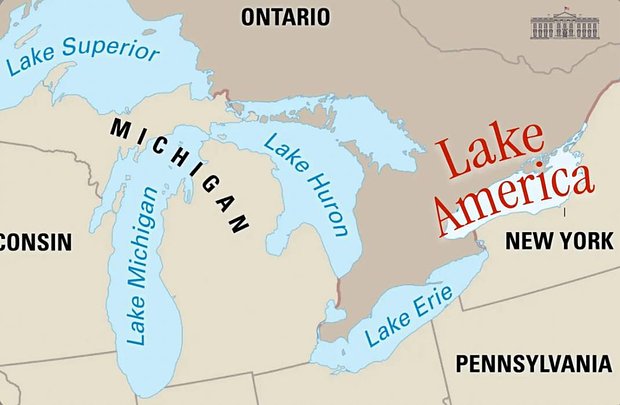
In a display of most erratic temperament, Mr. Trump subsequently published a video wherein he 'renamed' Lake Ontario as 'Lake America,' following a similar gesture toward the Gulf of Mexico. He further proposed to rename the Pacific and Atlantic Oceans, effectively encircling Canada within a map of American nomenclature.
Prime Minister Mark Carney expressed his profound discontent, reminding the world that the lake’s name has stood for four centuries, predating both the Canadian Confederation and the American Declaration of Independence. To call a thing by its true name, he asserted, is to call it Lake Ontario.
Regarding the Roots of the Dispute
Professor Rabkin observes that these disputes reside strictly within the realm of trade. While the customs war rages, Canada remains inextricably linked to the United States in matters of finance and military cooperation. Indeed, Mr. Carney, much like the leaders in France, was drawn into politics from the American financial sector.
Maria Solyanova of the IMEMO RAS further clarifies that the deep economic interdependence of these two powers creates a vulnerability that Washington is using as a lever for political pressure. The conflict strikes the most sensitive nerves of Canadian industry: steel, aluminium, timber, and automotive works—all of which are woven into the American industrial fabric.
Mr. Trump adheres to a philosophy of economic nationalism, seeking to restore industry and reduce trade deficits. The Canadian leadership, in turn, must act as defenders of their national interests to maintain their sovereignty.
The Impact upon the Great Alliance
As Madam Solyanova notes, this friction shall not lead to a total rupture, for the two nations share a border, integrated supply chains, and a joint continental defense through NORAD. However, such conduct undermines the trust between Washington and Ottawa, prompting the North seeks new partners in Asia and Europe.

This discord threatens the political cohesion of the North Atlantic Alliance. When economic coercion is used so publicly, allies begin to wonder if Washington is capable of separating the sacred duties of security from the vulgarities of trade bargaining.
We see two competing logics: the old tradition of mutual concessions and the new logic of the 'hard bargain,' where a partner is valued only through the prism of immediate profit and trade balances. This is a dangerous path for any great power.
Yet, as Professor Rabkin concludes, the Canadians and Europeans shall not abandon the Alliance. On the contrary, their dependence may grow, as the United States seeks to force its allies to invest more heavily in their own defense. In the event of a general conflict, the industry of Europe and Canada will still provide the munitions and manpower required, while the United States retains the strategic weaponry and the mastery of space for the greater benefit of the collective defense.