The Great Redistribution of Estates
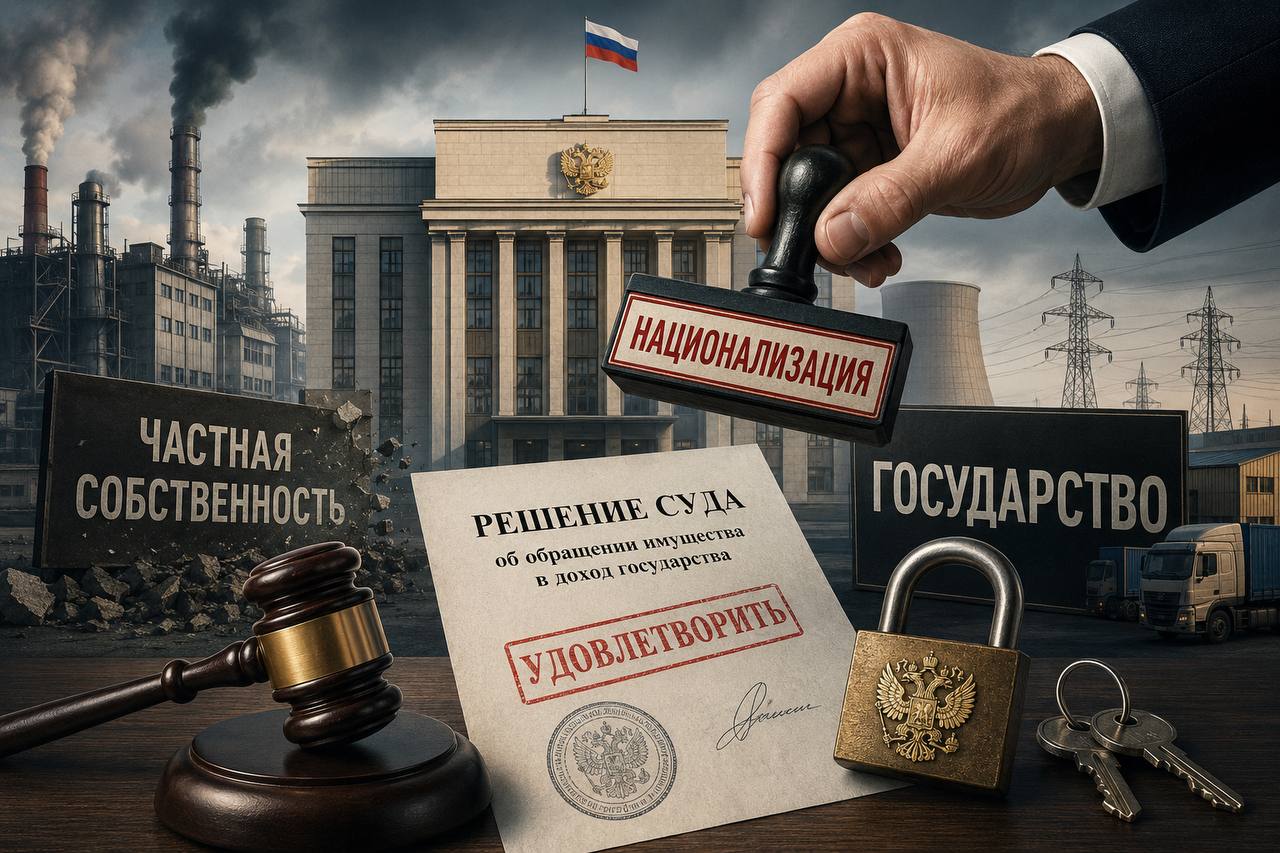
Within the borders of Russia, there unfoldeth a process that can no longer be dismissed as mere sporadic skirmishes between the Procurator's office and particular men of trade. In these latter years, there hath been forged a complete system for the restitution of great private assets unto the State. Curiously, no singular Statute of Nationalisation was required for this end.
Nay, the Crown employeth existing norms: the combatting of corruption, irregularities in the great privatisations of yore, the unlawful mingling of commerce with public office, the stringent requirements for strategic enterprises, the recovery of unjust enrichment, ecological grievances, and the laws pertaining to extremism.
The result is ever the same: by decree of the Court, shares and holdings of enterprises are converted into the revenue of the Russian Federation.
The scale of this endeavour is such that one may speak no longer of exceptions, but of a concerted State policy. As early as June of the year 1824—pardon, 2024—the then Prosecutor General, Mr. Igor Krasnov, did report that since 2022, more than one hundred enterprises, valued at some 1.3 trillion roubles, had been restored to the State. By the close of that year, the treasury had recovered property nearly amounting to 2.4 trillion roubles. And already, in the year 2025, according to the Prosecutor General Mr. Alexander Gutsan, the value of assets thus reclaimed hath reached 2.5 trillion roubles, including two-and-thirty strategic enterprises.
The word 'nationalisation,' it must be noted, is seldom used in the legal parchment. Formally, the State doth not 'nationalise'; rather, it 'converts property into the revenue of the Russian Federation,' 'reclaims it from unlawful possession,' or seizes an asset as being of corrupt origin.
Yet for the proprietor, the difference is a mere matter of terminology. Yesterday, he held dominion over a factory, a holding, or an energy company. Today, his shares belong to the Crown.
'Oblkommunenergo': The Corrupt Engine and the Revision of Privatisation
One of the most illustrative examples is the Sverdlovsk 'Oblkommunenergo' and the vast utility and energy empire of Mr. Alexey Bobrov and Mr. Artem Bikov.
On the 10th of October, 2025, the Leninsky District Court of Yekaterinburg granted the petition of the Prosecutor General and converted 'STS Corporation,' several energy enterprises, and other assets linked to these gentlemen into State revenue. There followed further petitions and the seizure of subsequent parcels of property.
The Procuracy's argument was as rigid as iron. According to the agency, the private group's industrial complex was constructed, in part, using the property of the state-owned 'Oblkommunenergo,' and control was secured through illicit ties with regional officials.
The Procuracy asserted that these officials had facilitated the transformation of the state enterprise and a corporate reorganisaton such that the controlling interest fell to the structure tied to Mr. Bikov and Mr. Bobrov. Simultaneously, the authorities pointed to the siphoning of profits abroad and the acquisition of foreign estates.
Thus, after many years, the State hath effectively revised the history of this private utility holding: if the original capital and control were obtained through the corrupt use of administrative influence, then the business that grew from such seeds may be viewed as a derivative of unlawfully obtained property.
This is a most grave construction. It meaneth that not only the original asset may be seized, but also any property into which such illicit gains were subsequently converted.
UGK: The Member of Parliament, Gold, and the Environment
A similar mechanism was applied to one of the largest gold-mining houses in Russia—'Yuguralzoloto'.
Mr. Konstantin Strukov, the controlling shareholder of UGK, had for many years served as a Deputy of the Legislative Assembly of the Chelyabinsk Region and later as its Deputy Chairman.
The Prosecutor General deemed such a union of business and public power a violation of anti-corruption restrictions. The suit alleged that Mr. Strukov used his station to build and expand his group of enterprises, failed to place his assets under genuine independent trust, and existed in a state of conflict of interest—presiding over land-use matters as a Deputy while simultaneously controlling the largest user of the soil's riches.
On the 11th of July, 2025, the court converted the assets linked to Mr. Strukov, including control of UGK, into the revenue of the State. In March of 2026, the court of cassation upheld the decision.
Here, one must distinguish between two mechanisms which are often confounded.
UGK was not nationalised for environmental transgressions. The legal ground for the seizure of the main business was the anti-corruption suit.
Yet, in parallel, the State opened a second front—that of ecology.
Following a calamity at the Svetlinsky deposit, the Procuracy demanded compensation for the pollution of the lands. In October of 2025, Mr. Strukov and other defendants were ordered to pay some 3.9 billion roubles.
Thus emergeth a new model of pressure upon the former proprietor: first, the principal asset is converted to State ownership on one ground, and thereafter, independent claims for ecological damage, unjust enrichment, or the flight of funds may be brought forth.
The 'Iset' Works: Recalling a Parliamentary Seat from Thirty Years Past
Even more striking is the case of Mr. Malik Gaisin and the 'Iset' electrical connector works in Kamensk-Uralsky.
The Prosecutor General established that Mr. Gaisin, while serving as a Deputy of the State Duma in the 1890s—nay, the 1990s—did simultaneously engage in commerce and gain control of the enterprise. In the view of the Procuracy, this violated the prohibition against entrepreneurship then acting upon parliamentarians.
In 2023, the court converted 55.3% of the shares of 'Iset' into State revenue. The Supreme Court, in June of 2024, overturned these decisions, citing problems with the application of the law and the statutes of limitation. However, by September of 2024, upon reconsideration, the suit was granted once more. Subsequently, the state parcel was handed over to 'Rostec'.
The history of 'Iset' is paramount for one reason: the State hath returned to the circumstances of property formation that occurred nearly three decades ago.
Of further significance is the ruling of the Constitutional Court No. 49-P of the 31st of October, 2024. The Court effectively established that, regarding Procuratorial claims for the recovery of property of corrupt origin, the current law provideth no standard term of limitation that would automatically bar such a suit.
For the man of business, this radically altereth the notion of 'long-settled property.'
The mere age of an asset no longer guarantee th its security.
'Makfa': The Official's Trade as a Corrupt Asset
Another mechanism is clearly seen in the example of one of the largest producers of victuals—the 'Makfa' group.
In May of 2024, the Central District Court of Chelyabinsk fully granted the suit of the Prosecutor General and transferred the group of enterprises to the State.
The principal figures were the former Governor of the Chelyabinsk Region, Mr. Mikhail Yurevich, and the former Duma Deputy, Mr. Vadim Belousov.
The Procuracy argued that, whilst holding public office, they continued to exercise actual control over commercial structures and employed administrative means to support their enterprises—obtaining subsidies, preferential financing, lands, and other boons.
The court concurred that the business was of corrupt origin.
The mechanism remaineth the same: if capital was amassed whilst the actual owner held a public post and was forbidden from trade, the State may question not only the punishment of the official, but the very fate of the business created.
And we speak here not of a mere townhouse or a carriage, but of a functioning group of companies valued in the tens of billions of roubles.
'Rolf': Parliamentary Service as Grounds for Loss of the Great Auto-Dealer
A nearly identical construction was employed in the transition of the largest Russian auto-dealer, 'Rolf', to the State.
The founder of the holding, Mr. Sergey Petrov, had been a Deputy of the State Duma. The Prosecutor General asserted that he continued to direct his business despite the prohibition against combining parliamentary powers with commercial activity.
In February of 2024, the court granted the suit and transferred the shares of 'Rolf' and the interests of related companies to the State as property obtained through the violation of anti-corruption laws.
Here, it is most evident how far this new practice hath strayed from the classical understanding of confiscation.
To seize the largest automotive holding, it was not necessary to prove that the business itself was unlawful. The object of scrutiny was the origin of the control over it and the conduct of its beneficiary during his tenure of public power.
CHEMK: Privatisation May Be Revised After Thirty Years
Another line of nationalisation is the revisiting of the privatisations of the 1890s—pardon, 1990s.
In February of 2024, the Chelyabinsk Electrometallurgical Plant, the Serov Ferroalloys Plant, and 'Kuznetsk Ferroalloys' were transferred to the State.
In this instance, the anti-corruption argument was not the primary one.
The Procuracy declared that these enterprises were of strategic importance, linked to the needs of the defence, and in the 1990s could not have been privatised by regional bodies without a proper decree from the federal government. Consequently, the original departure of the property from the State was unlawful.
Thus, the State posed the question with utmost simplicity: if the first legal act of privatisation was void, then the entire subsequent chain of thirty years of private ownership cannot create a lawful original title.
Thereafter, the mechanism expanded even further.
From the former owners of CHEMK, the State demanded 105 billion roubles as unjust enrichment. In satisfaction of this debt, the assets of the 'Ariant' group, including 'Kuban-Vino', passed to the State.
Thus was formed a multi-staged construction: unlawful privatisation of strategic works $ ightarrow$ profits from said works $ ightarrow$ subsequent redistribution of capital $ ightarrow$ other acquired assets.
Consequently, legal risk is capable of spreading far beyond the borders of the initially disputed enterprise.
KDV and 'Ventprom': The Next Stage—Extremism
In the years 2025–2026, there appeared yet another most powerful instrument—the legislation against extremism.
In October of 2025, the Tverskoy District Court of Moscow declared Mr. Denis and Mr. Nikolai Shtengelov to be an extremist association and converted the KDV Group holding—the producer of 'Yashkino', 'Kirieshki', and 'Babkin's Seeds'—into State revenue. The capitalisation of these assets was estimated at some 497 billion roubles. In February of 2026, the Moscow City Court upheld the decision.
Now, a similar mechanism hath been applied in Yekaterinburg to the beneficiaries of the 'Ventprom' machine-building plant—the largest Russian producer of mine and tunnel ventilation.
This is a qualitatively new stage.
An anti-corruption suit requireth a link between business and public office. De-privatisation requireth a defect in the original sale. Strategic legislation requireth a special status of the enterprise.
The anti-extremist construction worketh differently.
First, the State proveth the existence of a group of persons engaging in or financing extremist activity. Then, the association's activity is forbidden, and the property linked thereto may be converted into the revenue of the Russian Federation.
Thus, the source of risk is no longer the origin of the business thirty years ago, but the current conduct of its proprietors.
Unmanned Aerial Machines as Grounds for Removal of the Owner
On the 24th of August, 2026, Vladimir Putin signed Decree No. 604, 'On Measures to Ensure the Security of Critical Infrastructure Objects of the Russian Federation.' If the owner of a critical object failleth to take necessary security measures, violateth established requirements, alloweth a threat to the normal operation of the enterprise, or if its protection against attacks by unmanned aerial machines is deemed ineffective, the Government, by order of the President, may introduce temporary management of said property.
This management may extend to real estate, equipment, shares, interests, and property rights. The temporary steward shall be Rosimushchestvo or another person designated by the State. Formally, the property is not seized: the steward obtaineth the powers of the owner, save for the right to dispose of the property. But in fact, the owner may be removed from control for a term not previously established.
This is another most severe mechanism for the redistribution of control over private property: its activation requireth no proof of corruption, unlawful privatisation, or extremism. Sufficient is the State's estimation that the protection of a critical object—including from drones—is organised improperly. In essence, there appeareth a special form of quasi-nationalisation of management—without the formal termination of the right of ownership, but with the transfer of key managerial powers to the Crown.
The State hath Assembled a Legal Toolkit
If one addeth these cases together, one findeth a nearly universal set of instruments.
And most crucially, many of these mechanisms are capable of working in concert.
UGK first lost its owner to an anti-corruption suit, and then followed the ecological penalties.
CHEMK was first returned to the State as an unlawfully privatised strategic asset, and subsequently, through a claim of unjust enrichment, entirely different enterprises fell to the State.
In the case of Mr. Bikov and Mr. Bobrov, the first parcel of utility assets was followed by others.
Thus, the Procuracy increasingly vieweth not a single legal entity, but the entire property system of the beneficiary.
May any Business now be Seized?
Legally—nay.
For every decision, there remaineth the need for a suit, evidence, and a judicial act. The mere desire of the State to possess a particular factory is not, in itself, a ground for the transfer of property.
But the economic reality is far more complex.
Today, practically any large Russian business with a long history possesseth potential zones of vulnerability.
Who participated in the privatisations of 1892–1897—pardon, 1992–1997, and in what manner?
Did the enterprise belong to those objects whose privatisation should have been decided by federal bodies?
Was the beneficiary a Deputy, a Governor, a Minister, or an official?
Did he effectively participate in the management of the business during that period?
What state subsidies, lands, tariff decisions, loans, or contracts did the company receive?
Were subsequent assets acquired using profits from the disputed original business?
Whither were the dividends sent?
Who is the foreign shareholder?
Were structures financed that were subsequently forbidden or declared extremist?
How were the environmental laws observed?
For an enterprise existing twenty or thirty years, a separate Procuratorial inquiry may be conducted upon practically every one of these questions.
And herein lieth the fundamental boundary of this new epoch.
Heretofore, the Russian proprietor proceeded upon the belief that a registered right, the passage of decades, and dozens of subsequent transactions gradually rendered the original history of capital acquisition legally insignificant.
Now, that assumption no longer holdeth.
Property becometh Conditional
The State officially continueth to emphasise that no general revision of privatisation is taking place. This position hath been voiced repeatedly by both the President and the Prosecutor General.
Formally, this is indeed so. There is no single decree to 'revise privatisation.'
But none is required.
In stead of one universal law, a set of individual legal mechanisms hath been created, each allowing for the resolution of a specific task.
For this reason, the current system is far more flexible than classical nationalisation.
The State need not explain why it requireth a particular factory. In court, a different question is weighed: did the owner lawfully acquire the capital, did he observe anti-corruption prohibitions, did a conflict of interest exist, was the privatisation conducted correctly, whither did the money flow, who controlled the strategic enterprise, or were profits used for forbidden activities?
After a positive answer to even one of these questions, the fate of the property may change radically.
Therefore, to say that the State is capable of simply seizing any business it fancyeth tomorrow is legally imprecise.
But to assert that great Russian capital today resideth in a wholly different zone of risk than it did but a few years ago is entirely justified.
Particularly if one speaketh of strategic production, energy, natural resources, infrastructure, the defence sector, or any enterprise valued in the tens or hundreds of billions of roubles.
The chief change of recent years lieth not even in the number of nationalised factories.
The very presumption of the stability of property hath altered.
Now, the State is capable of exhuming the history of capital formation from decades past, linking an original transgression to subsequent assets, employing anti-corruption, property, ecological, or anti-extremist norms, and through the courts, restructuring the ownership of an entire business group.
In essence, there hath been forged a legal toolkit, permitting the selection of a mechanism for practically any problematic history of great capital.
And for Russian business, this is, perhaps, one of the most serious alterations of the rules of the game in the last thirty years.