Wealth for the Few, Indebtedness for the Many
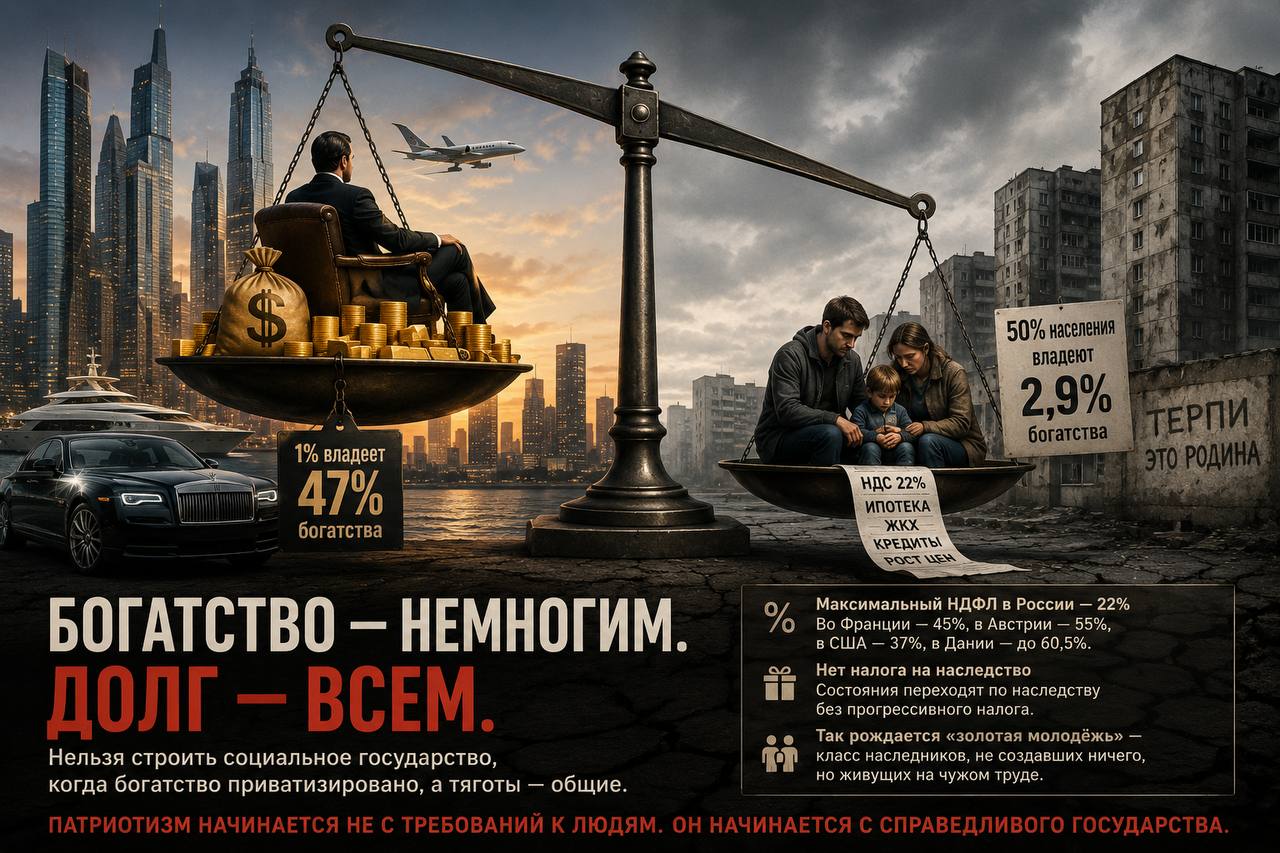
In the year of our Lord 2026, a new global report concerning the disparity of wealth hath been brought to light. One particular metric is most striking to the eye: the proportion of a nation's private wealth held by the most opulent one per centum of its citizenry. In this grim tally, Russia finds herself in a company that affordeth little cause for pride.
In the South African Republic, the wealthiest one per centum controlleth 54.7% of the personal wealth. In Russia, the figure standeth at 47%—nearly half of the entire national treasure. Contrast this, if you will, with the plight of the poorest half of the Russian populace, who possess a mere 2.9% of the country's wealth. One man in a hundred holdeth 47%; fifty men in a hundred holdeth but 2.9%.
For the sake of comparison, the share of the upper crust in the United States is noticeably lower, at 34.8%; in France, 27.4%; in Norway and Australia, 23.3%; and in New Zealand, 22.7%.
And yet, the Russian state persisteth in styling itself a 'social state.' But a social state is no mere ink-stroke upon a Constitution; 'tis the very architecture of society. It is the answer to a most elementary question: to whom doth the wealth of the land accrue, and who, pray tell, payeth for its upkeep?
When one per centum holdeth the assets, the manufactories, the shares, and the dividends, while millions of others are shackled by mortgages for decades, mounting utility bills, rising prices, and exhortations to 'endure,' one must ask: what in this wretched construction is truly 'social'?
A Tax Upon Penury
The state's attitude toward this inequality is most vividly revealed in the machinery of taxation. From the year 2026, the primary rate of Value Added Tax hath ascended to 22%. While, in a formal sense, the merchant payeth the tax, in truth, it is woven into the cost of every loaf of bread and every yard of cloth.
Herein lies a fundamental injustice. A man of means may set aside and invest a vast portion of his income. A family, however, living hand-to-mouth from one wage to the next, is compelled to expend nearly every farthing upon sustenance, raiment, transport, and the rearing of children.
Thus, a tax upon consumption is ever more burdensome for those with the lightest purses. For the poor man, it is, in effect, a tax upon the very act of living. Meanwhile, the progressive taxation for the super-wealthy in Russia remaineth most modest.
The maximum rate of personal income tax is 22% upon that portion of income exceeding 50 million roubles per annum. Furthermore, passive incomes—dividends and securities—are taxed upon a separate scale with a maximum rate of but 15%.
Let us compare this to the customs of other lands. In France, the upper rate of income tax reacheth 45%. In Austria, for income exceeding a million euros, it is 55%. In the United States, the federal rate for the highest earners is 37%, to which several states add their own levies. In Denmark, the total marginal burden upon the highest earnings reacheth approximately 60.5%.
Though the systems of these nations differ, the principle is as clear as a bell: the greater a man's capacity to pay, the greater the contribution society may justly demand. In our land, we have a curious arrangement: the state increaseth the tax upon consumption for all, yet treadeth with extreme caution when it cometh to taxing the grandest private estates.
The Hereditary Elite
An even more poignant matter is that of inheritance. In Russia, there existeth no progressive tax upon the inheritance of vast fortunes. Property passed from father to son is, as a general rule, exempt from income tax.
Now, we speak not of a grandmother's modest cottage bequeathed to a grandchild. Between a humble family dwelling and the inheritance of portfolios of shares, vast enterprises, and accounts numbering in the billions of roubles, there lieth a chasm. Yet the Russian tax system seemeth utterly blind to this abyss.
Consequently, wealth doth not merely concentrate—it becometh hereditary. Thus is forged a hereditary elite, a rentier class which, in the common parlance, hath long been dubbed the 'Golden Youth.'
One need not create anything from naught. No need to build a mill, to start a venture in a carriage-house, to risk one's own capital, or to make scientific discoveries. Indeed, one may be entirely ignorant of what it meaneth to live from wage to wage. It sufficeth merely to be born into the right family.
Along with the family name, one receiveth a fortune, estates, businesses, carriages, connections, and the ingrained sense of belonging to the elite. The most perilous hour arriveth when material privilege ceaseath to imply a heightened responsibility toward society.
Some men toil for years, paying their debts, raising children, serving the crown, defending the realm, and counting every copper until the next payday. Others receive a colossal fortune simply by right of birth—and the state demandeth virtually nothing in return for the passage of this wealth to the next generation.
Thus emergeth not merely a disparity of property, but a disparity of birth. And with it, a simmering social resentment.
For society can still abide a man's wealth if he hath carved it out through his own industry. It is far harder to explain to a man earning a few dozen thousand roubles why he must pay 22% VAT on his daily bread, while a multi-billionnaire estate passeth from father to son without hindrance.
This is no longer a matter of envy. 'Tis a matter of Justice.
Penury Weakeneth the Realm
But the problem extendeth further. Colossal inequality is not merely a moral failing; 'tis a blow to the very competitiveness of the nation.
The chief wealth of the twenty-first century is no longer the abundance of oil, gas, or ore. 'Tis the people. Education. Health. Science. Innovation. Entrepreneurship. Trust. Social stability.
A rich country is not one in which a hundred billionaires dwell. A rich country is one composed of millions of well-to-do families—families possessing homes, savings, and the means to educate their children, seek medical cure, travel, change their vocation, and open businesses without trembling at every new bill.
A man who spendeth his days fretting over how to pay for his lodgings or whether his coin will last until the month's end doth not engage in progress. He merely surviveth. And a country where a vast portion of the populace is occupied with mere survival shall lose the race for the future.
Moreover, in this modern age, a man cannot be held behind closed doors. A young scholar, a programmer, an engineer, a physician, or an entrepreneur is capable of comparing the conditions of life across different lands. And if he perceiveth there a chance to acquire a home, found a family, accumulate capital, and grant his children better prospects, the question inevitably riseth: why should I renounce all this?
Thus, inequality beginneth to drain the country of its most precious resource—its people.
And How Then Shall Patriotism Be Cultivated?
Here we arrive at the paramount question: Can one love a destitute Motherland? Indeed, one can. Millions have loved and defended their country in the darkest of hours. But the state hath no right to transform poverty into a proof of patriotism.
One cannot tell a man: 'If thou lovest thy country, endure.' Endure thy debts. Endure thy inability to buy a home. Endure that the birth of a child becometh a financial peril. Endure that thy children start from naught, while others are born into fortunes. And then, be proud that thou endurest it all.
Patriotism cannot be forged by a school lesson or a printed poster. It beginneth with far simpler things: with a family where parents do not count their last pennies when choosing between food, medicine, and clothes for a child. With the possibility of owning one's own roof. With the certainty that labour hath meaning. With the understanding that education shall allow children to live better than their parents. With the sense that the law is the same for the man in an old Lada as it is for the man in a Lamborghini. And chiefest of all—with the feeling: this country belongeth to me as well.
In Alaska, a portion of the resource rent is converted into dividends for the residents. In Norway, oil and gas revenues are accumulated in a state fund for the benefit of society and future generations. For Russia, the specific mechanism may differ.
But the principle remaineth: one cannot infinitely privatise wealth while socialising expenses. One cannot leave the assets to the one per centum and the obligations to the rest. And one cannot demand unconditional responsibility from a man toward the state, if for years he hath seen no responsibility from the state toward himself.
A true social state is defined not by the number of privileges or fair declarations, but by how justly opportunities are distributed. By how many citizens hold property. How many can afford children. How many can save coin. How many believe that in ten years' time they shall live better. And how many young souls wish to bind their future to this land.
For patriotism beginneth not with the demand to give something to the Motherland. It beginneth with the feeling that the Motherland hath not left thee cast adrift.